


AI-to-Human Handoff, Explained: How AI Agents and Staff Share the Phone
Not every call can be resolved by AI—and that's by design. Learn how AI-to-human handoffs keep every patient call moving...
 Appointment Scheduling
 Waitlist Management
 Confirmations & Reminders
 Patient Recall & Outreach
 Front Desk 24/7
 New Patient Intake
 Prescription Refills
 After Hours Support
 Messages in Your EHR
 FAQ Automation
 Phone: Inbound & Outbound
 Text: SMS & Forms
 Website Chat
 Voicemail Replacement
 Spanish & Multilingual
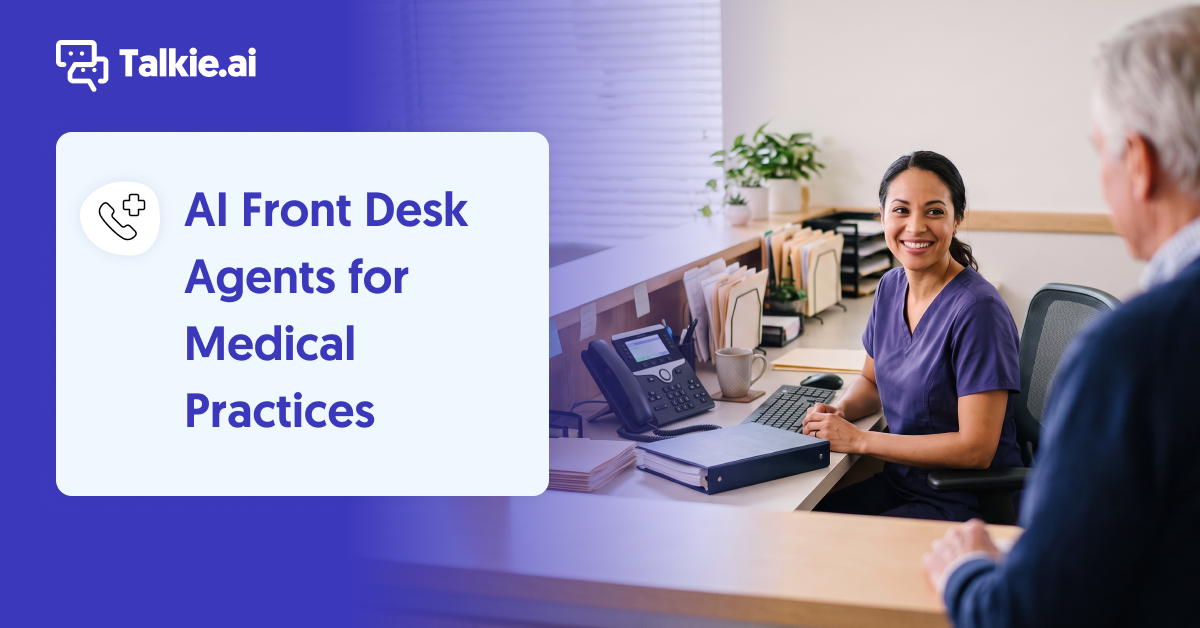
At a busy medical practice, the phone rarely stops, and during peak hours calls arrive faster than any one person can answer. An AI front desk agent takes that weight off your team: it answers every call, text, and chat, handles what it can on the spot, and logs the rest in your EHR. For most practices, it’s the lowest-risk, highest-return way to start using AI.
This guide covers what an AI front desk agent is, why the front desk is the smartest place to start with AI, what these agents actually do, how they differ from the tools you’ve already tried, how to choose one, and what happens once patients start using it. Each section points to a deeper article if you want to go further.
An AI front desk agent is software that answers your practice’s phone (and text and chat), understands what the caller needs in natural language, and completes the task—booking the appointment, taking the refill request, answering the question, or routing an urgent call to the right person.
The key word is completes. A traditional phone menu only routes the caller. A voicemail box collects messages. An AI front desk agent resolves the reason the patient called, then writes the outcome back into your EHR with full context.
A capable agent can speak multiple languages and take many calls at the same time, and unlike a person, it never takes lunch, leaves at 5, or quits in six months.
The same agent also works outbound, placing appointment reminders, confirmations, and patient recall calls, so it brings patients in as well as answering the ones who call you.
For the full breakdown of the tasks these agents handle, see What Can AI Virtual Agents Do in Healthcare? and How AI Voice Agents Are Redefining Productivity for the Medical Front Desk.
It’s natural to assume AI should go somewhere clinical or high-tech. But the front desk is the lowest-risk, highest-impact place to begin, precisely because the work there is high-volume, repetitive, and non-clinical.
Three reasons the front desk comes first:
As Ada Andruszkiewicz, Co-founder and COO at Talkie.ai, put it on the Healthcare IT Today podcast:
There is extreme variability and intensity of contact in healthcare. On a Monday morning, when your peak kicks in at 8, the intensity of those calls is 20-30 fold to what your other hours are.
You can’t hire your way out of a 20-fold surge that lasts an hour. But you can automate your way through it.
We make the full case in Why Your First AI Medical Virtual Assistant Should Be at the Front Desk and 7 Reasons Why Medical Practices Are Turning Toward AI Front Desk Agents.
A capable agent goes well beyond picking up. Inside your EHR, it can:
If you’ve tried other fixes for the phones, you already know their limits. Here’s how an AI front desk agent compares.
Tool |
What patients get |
The gap |
IVR (“press 1 for…”) |
A menu |
Patients get lost, mis-route, or hang up |
Voicemail |
A place to leave a message |
No resolution; someone still has to call back |
Answering service |
A human who takes a message |
Limited access to your systems; booking or resolving may fall back to your team |
Extra hire |
One more person on the phones |
Still one conversation at a time, still off after hours |
AI front desk agent |
A resolved request, 24/7 |
Books, refills, answers, routes, and reaches out to patients per your instructions—and logs it all inside your EHR |
The answering-service comparison is worth its own read, especially for after-hours: Beyond the Answering Service: How to Capture More Patient Bookings After Hours.
A good AI agent removes the bottleneck that keeps your team from doing their real work.
Tiffany Burke, an independent consultant with 22 years in healthcare IT and practice management, described the shift on our Scaling Practice Management podcast:
[AI agents] take a lot of the burden off of specifically the front desk and the admin teams. And it opens up a spot for them to be able to actually get other things done.

Tiffany Burke
Healthcare IT & practice management consultant
When the phone stops owning your front desk, staff can clear documentation backlogs, work the schedule, and give the person in front of them their full attention. That’s also better for patients: rushed calls and unreturned voicemails are how practices feel impersonal in the first place.
We dig into that in Can AI Make Healthcare More Human? and into the staffing side in 5 Ways to Stop Front Desk Burnout.
Hiring is expensive and only solves part of the problem. The U.S. Bureau of Labor Statistics puts the median wage for receptionists—the front desk role at most practices—at $19.00 an hour in healthcare as of May 2025, about $39,500 a year. That new hire still can’t take three calls at once, and still isn’t there at 8pm on a Wednesday. For a live side-by-side of Talkie against a new front desk hire, see our pricing comparison.
Additionally, the phone experience shapes how patients judge your access to care. A peer-reviewed study in the American Journal of Managed Care found that shorter telephone wait times were associated with better patient perceptions of their ability to get urgent care, even when actual appointment wait times hadn’t changed. How fast you answer the phone changes how patients rate you, independent of anything clinical.
Put those together and the front desk gap is costing you twice: in the staffing dollars you spend trying to cover the phones, and in the patients who slip away when you can’t.
Run your own version of the numbers with How Much Do Missed Calls Cost a Medical Practice? Here’s the Math.
Not all agents are equal, and the differences that matter most are the ones you can’t see in a demo script. Before you sign anything, pressure-test vendors on:
We turned this into a full checklist in 7 Must-Ask Questions Before Choosing an AI Agent, answered the common objections in the AI Front Desk Agents FAQ, covered whether AI can follow complicated rules in Can AI Scheduling Handle Complex Rules?, and explained how calls stay compliant in HIPAA-Compliant AI Patient Phone Calls.
Already comparing vendors on these criteria? See how Talkie measures up in Why Talkie.ai Is the Best AI Medical Receptionist for Healthcare Practices.
The worry is that patients will hate talking to “a robot.” In practice, what patients hate is waiting on hold, navigating menus, and leaving voicemails no one returns. An agent that answers on the first ring and resolves the request removes those frustrations.
Adoption still needs a plan—how you introduce the agent, what you tell patients, and how you handle the ones who prefer a person. We built a step-by-step resource for exactly that: Introducing AI at Your Practice: A Checklist for Improving Patient Adoption.
For the bigger picture on experience, see Patient Experience in Healthcare: The Simple Improvements That Make a Big Impact.
At ESD Pediatric Group, a two-location Cincinnati practice that has served families for more than 80 years, high call volume had pushed the scheduling team into a burnout cycle of sick days, short staffing, and sinking morale. After evaluating three vendors, the practice put Talkie’s AI agent “Jessica” on the phones, fully integrated with athenaOne.
It now handles over 6,000 calls a month, hold times fell from 20+ minutes to zero, and the scheduling team finally leaves on time.
I walked out with [the team] at 5:05, and they were just like, ‘Oh my gosh, we never get out of here close to 5. We’re usually out of here around 6.’ So they were all smiles.

Leasa Horst
Practice Administrator, ESD Pediatric Group
The gains compound when a practice builds around the front door. New Hope Primary Care is an AI-first internal medicine practice whose founder, Dr. Zeshan Rajput—a physician and medical informaticist—vetted Talkie against a strict human-in-the-loop AI policy before going live inside athenaOne.
Now about four in five calls are handled end to end and scheduled straight onto provider calendars. The practice runs deliberately lean, so Dr. Rajput picks up the overflow himself—now just three or four calls a day, an order of magnitude lower than a few weeks earlier.
It’s the number one way patients are scheduling their appointments. Even when we’ve made the portal available to them, patients are choosing on their own to call up Talkie.

Dr. Zeshan Rajput
Internal Medicine Physician and Owner, New Hope Primary Care
See more in our case studies.
The front desk shapes a patient’s first impression and their access to care, and it’s the lowest-risk, highest-return place to start with AI.
A capable AI front desk agent answers every call, text, and chat, resolves what it can inside your EHR, reaches out with reminders and recall, and hands the rest to the right person—relieving your team rather than replacing it. Practices like ESD Pediatric Group and New Hope Primary Care show the payoff: more calls handled, shorter waits, and staff who leave on time.
Ready to see it in action?
Watch an AI front desk agent handle your practice’s scheduling, refills, and after-hours calls inside your EHR.
What is an AI front desk agent?
Software that answers a practice’s calls, texts, and chats, understands what the patient needs, and completes the request—booking, refills, questions, or routing—directly in the EHR, around the clock.
How is an AI front desk agent different from an IVR or answering service?
An IVR hands patients a menu and an answering service takes a message; both still leave the real work for your team. An AI front desk agent resolves the request on the call and records it in your EHR.
Will an AI front desk agent replace my front desk staff?
No. It takes the repetitive phone load off your team so they can focus on the patients in front of them and higher-value work. More in 5 Ways to Stop Front Desk Burnout.
Does an AI front desk agent work with my EHR?
Yes, through native, two-way integration. Talkie integrates natively with athenahealth, ModMed EMA, Elation Health, AdvancedMD, and eMedicalPractice.
Does an AI front desk agent work after hours and in other languages?
Yes, 24/7, in English, Spanish, and 50+ other languages.
Does an AI front desk agent only answer calls, or can it reach out to patients too?
Both. A capable agent also places outbound reminder, confirmation, and patient recall calls, which cut no-shows and bring patients back for follow-ups.
Is an AI front desk agent HIPAA compliant?
Yes. Talkie is SOC 2 Type II certified and HIPAA compliant.
Where should we start?
Some practices begin with after-hours and overflow calls, then expand as they see it perform. See Why Your First AI Medical Virtual Assistant Should Be at the Front Desk.
Not every call can be resolved by AI—and that's by design. Learn how AI-to-human handoffs keep every patient call moving...
Looking to add an AI assistant to your medical practice? This buyer’s guide outlines key questions to ask vendors before making a...