Many healthcare practice managers are asking themselves the same question right now: where do we start with AI? The options can feel overwhelming. AI scribes for clinical documentation, AI tools for revenue cycle management, predictive analytics for patient outcomes, AI-assisted diagnostics… The list goes on and on.
Ask yourself a more useful question instead: where can AI make an immediate, measurable difference—without touching clinical decisions and without requiring a complete workflow overhaul?
The answer, for most practices, is the front desk.
In this article, we’ll cover why your first AI investment should be at the front desk and why it’s the smartest starting point: high impact, low clinical risk, and the kind of confidence-builder that makes every AI decision that follows easier.
We also draw from the insights of healthcare experts we interviewed in our podcast, Scaling Practice Management.
Key Takeaways
- The front desk is a low-risk, high-impact entry point for AI in a medical practice because the front desk deals with high-volume, low-complexity communication (calls, scheduling, reminders, FAQs)—the type of work AI can handle.
- Part of why it’s a high-impact entry point is that unanswered phones are a revenue problem. Every missed call is a potential patient lost to a practice that picked up.
- Starting at the front desk builds the organizational trust, internal experience, and operational data you’ll need before moving AI into more sensitive areas of your practice.
- Practices that wait until they’re forced to adopt new technology struggle more than those that move early.
- The key to helping staff adapt to AI is adjusting performance metrics to reflect the new division of labor when a new tool comes in.
- Technology in healthcare succeeds when it enhances the human experience rather than creating new barriers—a good medical virtual assistant should make patients feel more efficient, not more frustrated.
- The patient case for AI front desk virtual assistants is just as strong as the operational one: patients don’t want to wait on hold to schedule an appointment or wait for a callback.
- The data your AI front desk agent generates—peak call times, common inquiries, resolution rates—can become the foundation for other AI investments.
- The best way to learn AI is to start doing it. Find the processes that feel robotic and ask whether AI could handle them.
The front desk problem is made up of repetitive interactions
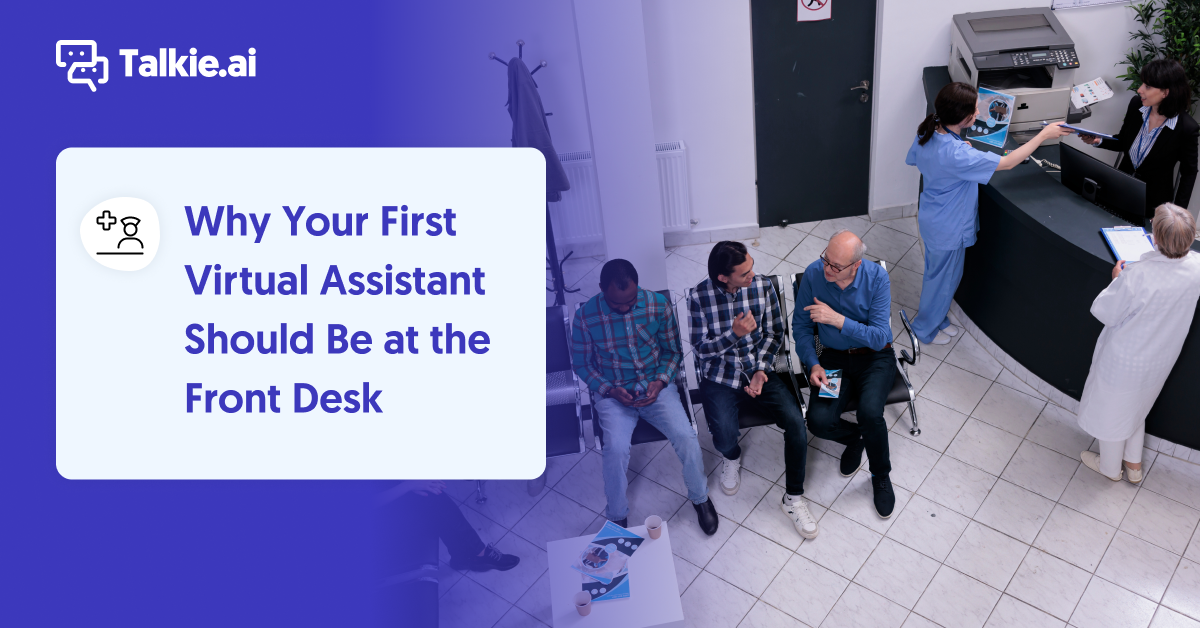
Walk into virtually any medical practice and you’ll find the same pain points: a phone that never stops ringing, front desk staff pulled in too many directions, patients stuck on hold, appointment requests that come in after hours and go unanswered until morning (or midday,) and a backlog of administrative tasks that never quite gets done.
Cheri Cobb, a growth and marketing expert who has spent 15 years helping medical practices reclaim missed revenue, sees it constantly: