





Why Your First AI Medical Virtual Assistant Should Be at the Front Desk
Missed calls, overworked staff, patients on hold—AI at the front desk fixes all three. And it's the lowest-risk, highest-impact way to start with...
 Appointment Scheduling
 Waitlist Management
 Confirmations & Reminders
 Patient Recall & Outreach
 Front Desk 24/7
 New Patient Intake
 Prescription Refills
 After Hours Support
 Messages in Your EHR
 FAQ Automation
 Phone: Inbound & Outbound
 Text: SMS & Forms
 Website Chat
 Voicemail Replacement
 Spanish & Multilingual
When practice managers first consider an AI phone agent, there’s one fear that comes up almost every time: What happens when the AI can’t help?
It’s a fair question. And it’s usually rooted in memories of older phone systems—rigid IVR menus where you’d press 1, then 3, then 0, hoping to reach a human, only to end up in a loop or disconnected entirely.
Modern AI agents are nothing like that. But the concern reveals something important about what practices actually need from an AI receptionist: a reliable partnership between AI and humans, where neither the patient nor the staff is ever left hanging.
That’s what an intelligent AI-to-human handoff should look like.
The frustration patients feel with automated phone systems is based on a different generation of technology.
Old IVR systems were rigid scripts. Press 1 for this, press 2 for that—and if your question didn’t fit a menu option, good luck. Those systems made patients feel trapped. Practice managers remember that experience too, which is why many are hesitant to put anything automated between the patient and their staff.
Modern conversational AI is fundamentally different. Patients speak naturally. The AI understands context, handles follow-up questions, and adapts to what the caller actually needs. And when it reaches the edge of what it can do, it doesn’t loop the patient back to a main menu—it connects them to a human or offers a clear alternative.
In fact, one of the key reasons practices switch from IVR to a conversational AI agent is a problem every front desk team knows: patients don’t listen to the menu. They press 1—or just mash 0—and end up in the wrong place. Someone calling about a refill lands with scheduling. A new patient gets routed to billing.
An AI medical receptionist that gathers context first and then routes accurately eliminates that entire category of waste.
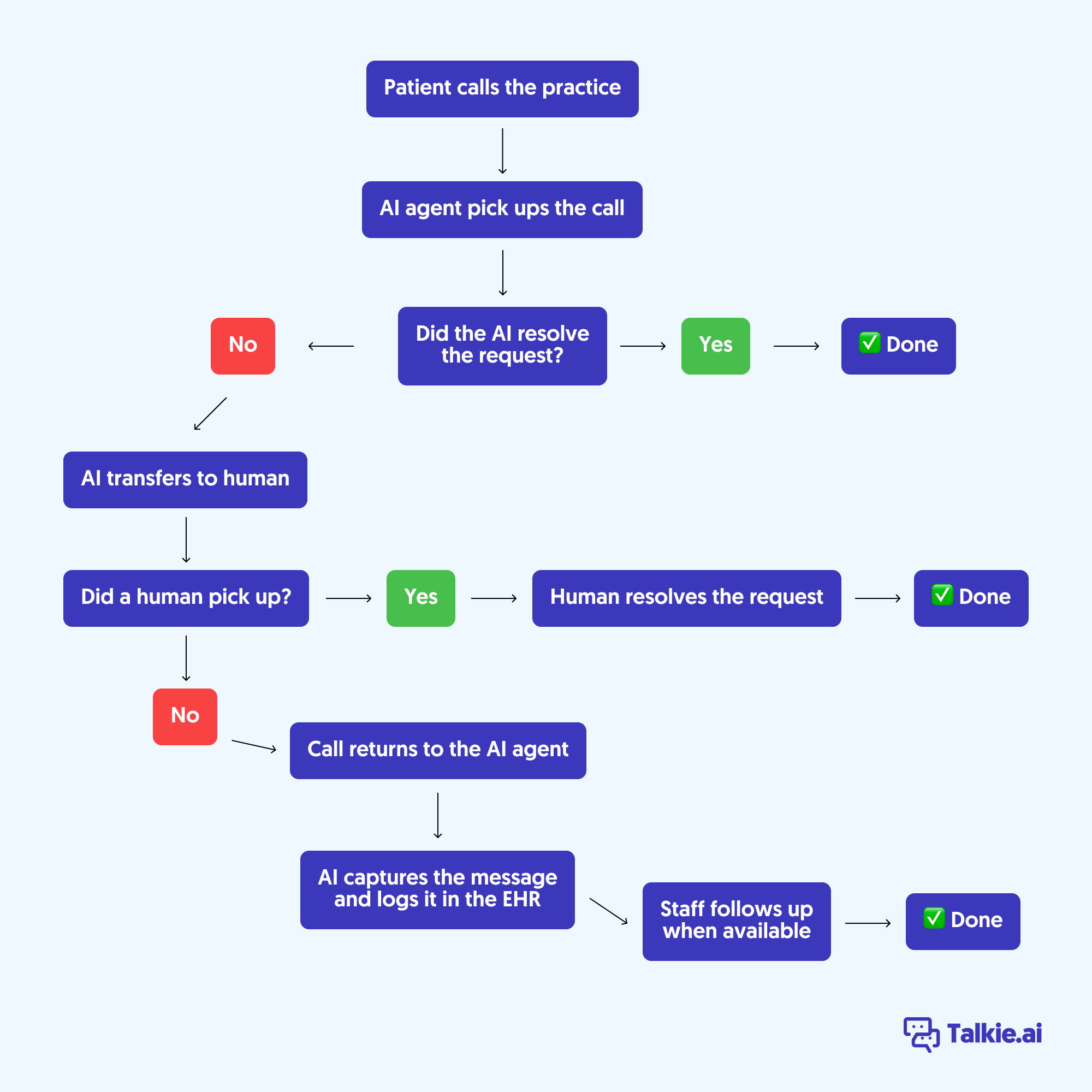
The best way to understand how AI and human staff work together is a relay race. The AI picks up the baton first—picking up the call instantly, without hold times, without burning out, without taking a sick day. It handles what it can: scheduling, refills, FAQs, smart call routing.
But there are moments when the baton needs to be passed, for instance when a patient is distressed, or a billing question gets complicated. In those cases, the AI recognizes the situation and hands off cleanly—a warm handoff with full context—to the right human.
Ashley Glisson, Senior Administrator at MHP Radiation Oncology Institute, describes the dynamic simply:
Talkie.ai is a virtual assistant to my front desk team. Nurses sometimes have assistants, doctors have assistants—but the front desk team doesn’t. Talkie is that assistant.
Ashley Glisson, Senior Administrator at MHP Radiation Oncology Institute
The relay works in both directions, too. A human staff member can hand the baton back to the AI when it makes sense, like when they’re too busy to talk—and the AI is always ready to pick up the conversation again.
When a call moves from AI to a human, it’s easy to assume something went wrong. In reality, most transfers fall into categories the practice deliberately configured—or that reflect the AI doing exactly what a good team member would do.
Most practices designate specific scenarios they want the AI to route to a human. This usually includes appointment types with complex booking rules, or insurance providers that require manual processing. If the AI is creating a patient chart and the caller mentions an insurer on the practice’s “transfer to human” list, it recognizes the flag and hands the call off according to the SOP. These aren’t failures—they’re the workflow working as intended.
Transfers can get even more specific than that. For example, if a patient calls with a question about their CPAP machine, the AI can be configured to route that call directly to the appropriate third-party provider’s number—no human involvement needed. The front desk staff doesn’t have to pick up the phone, listen to the request, and spend time looking up and relaying a third-party number.
Once the AI is trained on these types of requests, the transfers happen automatically, saving time on both ends.
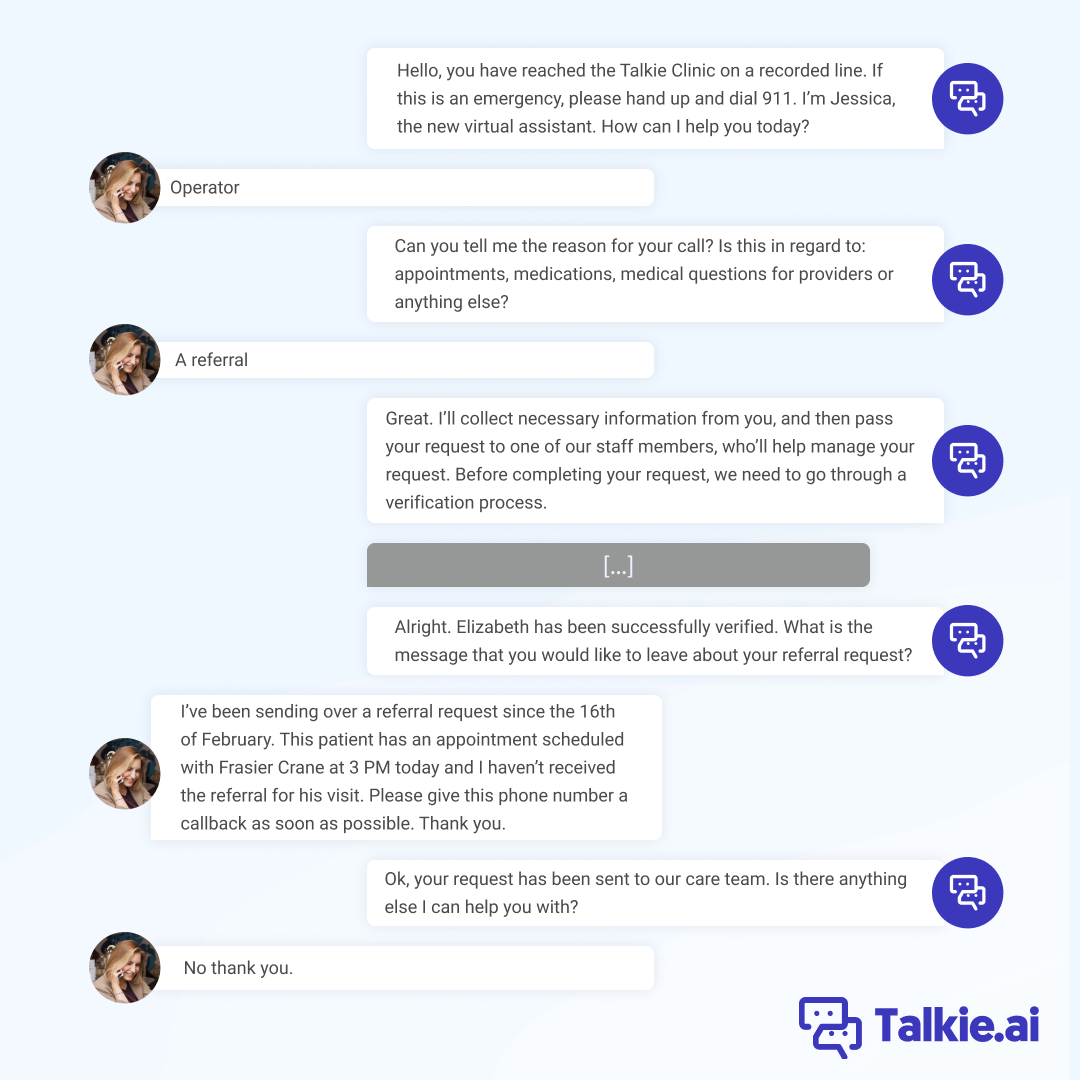
Sometimes the caller simply wants to speak to a person, and that’s perfectly fine. But even here, there’s a smarter approach than a blind transfer. The AI can first ask: What do you need help with? This takes a few seconds, but it means that when the call reaches a staff member, they already have context instead of starting from zero.
That brief intake can also reveal the patient didn’t actually need a human at all. Once the AI asks what they’re calling about and the patient explains, the AI can often resolve the request on the spot—recording, transcribing, and summarizing the message so it’s ready for staff follow-up without anyone needing to pick up the phone.
Here’s a real (anonymized) example of exactly that scenario:
Then there are the true edge cases—situations so rare they don’t justify building an automated workflow, because it’s not even clear upfront how they should be handled. These are best met with a simple principle: the AI recognizes it can’t help and offers to connect the patient with someone who can.
Here’s a real (and also anonymized) example from a recent call analysis. A patient called to check on their appointment details—something the AI handles routinely. But this one went differently:
Patient: “I don’t remember if I have any appointments booked with Dr. Crane. I’m confused.”
AI Agent: (after verifying the patient’s identity) “Let me check your file. I don’t see any visits on your file. Let me connect you with our staff who can assist you further.”
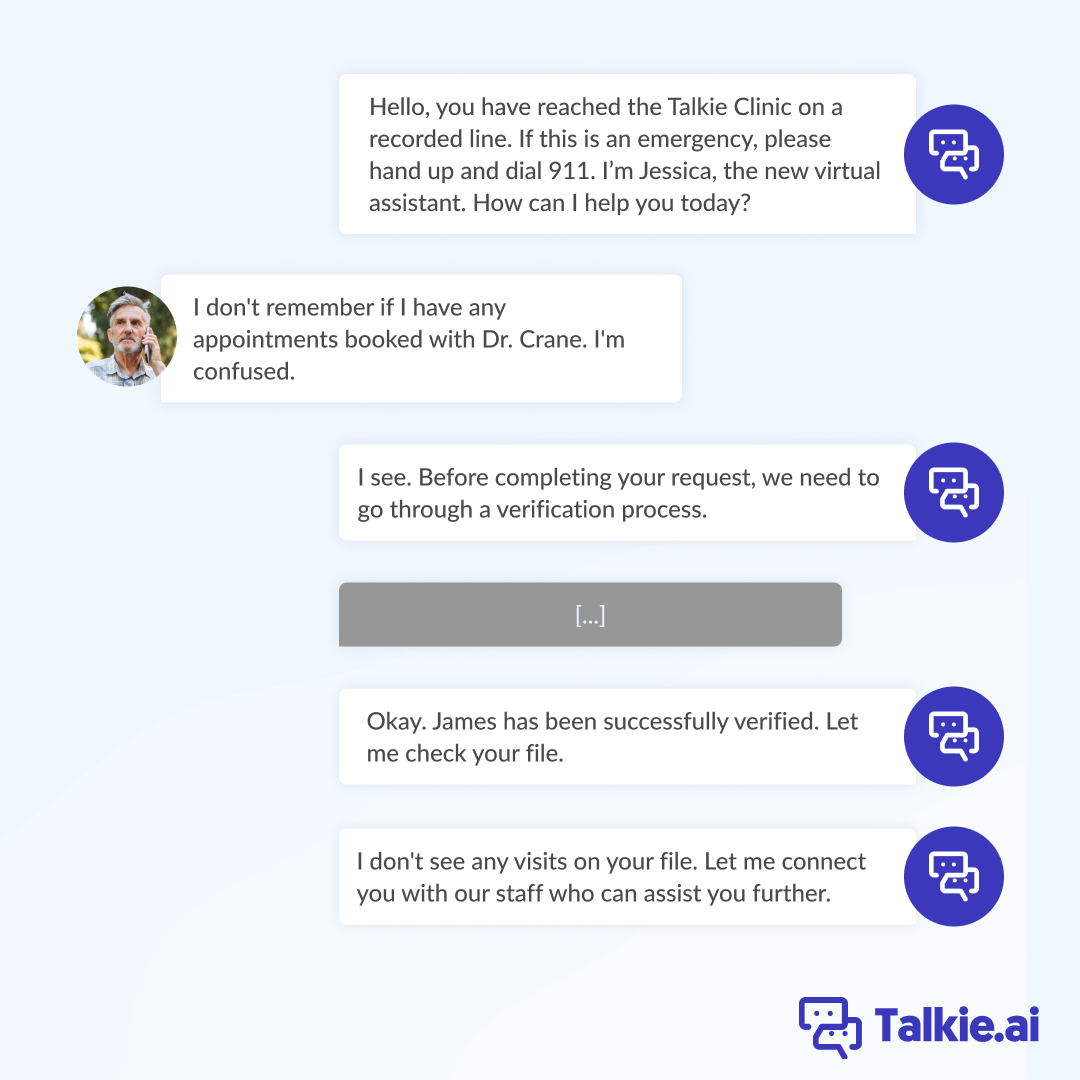
The AI could have simply said “no appointments found” and ended the call. But the patient was clearly confused—and a flat “no” wouldn’t have resolved their actual concern. The AI recognized it had exhausted its scope and that the patient still needed help, so it made the right call: transfer to a human who could dig deeper.
The relay works both ways. And this direction is just as valuable.
Your front desk team is juggling walk-in patients, EHR tasks, and phone calls simultaneously. When they’re occupied, calls that would normally ring out or go to voicemail can instead go to the AI. The agent picks up instantly, helps the patient with whatever it can, and logs everything.
One multi-location urology practice saw this in action: within one week of deploying Talkie as the first line of contact, voicemails dropped by 50%. The staff initially thought something was broken—it was just that the AI was resolving calls that previously would have gone unanswered.
As Evan Steele, Founder and CEO of Rater8, put it on the Scaling Practice Management podcast (brought to you by Talkie.ai):
The worst thing we see in our surveys is getting someone on the phone. If that problem could go away and instead of having three call center people, you could have one and then have AI agents… and if it becomes a sticky situation, then you get transferred to a live person.
Evan Steele, Founder and CEO of rater8
This dynamic extends to after-hours calls, too. When the human crew has finished work for the day, patients keep calling—and some of them will ask to be transferred. The AI agent serves as a critical triage layer: it filters out everything it can handle on its own and transfers only genuine emergencies to the on-call provider, following rules the practice sets. This prevents what many practices know all too well—on-call doctors fielding calls from patients who just want to reschedule a Tuesday appointment.
Your patients won’t get stuck with AI. And your staff won’t get stuck without it.
The AI-to-human handoff means every call has a path forward—whether that’s the AI resolving it in 30 seconds, a warm transfer to your team with full context, a neatly summarized message waiting in the EHR, or an after-hours triage that keeps your on-call provider focused on real emergencies.
The baton always moves. No step leads to a dead end.
See the relay race in action
Experience how Talkie’s AI agent works alongside your staff—picking up instantly, transferring smartly, and never dropping the ball.
Missed calls, overworked staff, patients on hold—AI at the front desk fixes all three. And it's the lowest-risk, highest-impact way to start with...

Introducing AI at your practice? Use this practical checklist to build patient trust, increase adoption, and make AI feel easy, familiar, and...