1. Blog
  2. /
  3. AI in healthcare
  4. /
  5. What Can AI Virtual Agents Do in Healthcare?

There simply aren’t enough hours in the day to handle all of the crucial tasks healthcare practices face everyday. As a result, medical staff is overworked, patients are frustrated, and delays are pervasive.

Hiring more people doesn’t always fix these problems—and often, it’s not even possible.

AI virtual agents are the solution.

They can unburden the front desk staff and actively work against delays, thus improving how staff and patients interact—24/7.

In this article, we’ll explore what AI virtual agents are, what they can do, and how your practice can start using them today.

What are AI Virtual Agents?

AI virtual agents are intelligent, conversational gen AI-based software programs that interact with people through voice (AI voice agents) or chat (e.g. live chat on websites).

Virtual agents can assist us in all manner of repeatable tasks. In the healthcare context, it’s tasks like:

  • scheduling appointments,
  • refilling prescriptions,
  • registering new patients,
  • routing calls, calling patients back and checking-in,
  • answering FAQs,
  • gathering approvals for transferring medical records,
  • and checking referral statuses.

These are some of the most practical and high-impact gen AI use cases in healthcare, especially when patients expect fast, natural interactions.

AI agents are also different from traditional chatbots, because they understand natural language and can carry context-aware, human-like conversations.

For instance, if you ask a voice agent to schedule an appointment but the date they suggest doesn’t fit your schedule, you can negotiate and discuss other possible dates, until you pick one that works for you.

And that difference is crucial: unlike rule-based chatbots, modern virtual agents in AI are dynamic and flexible, so they adapt to the patient’s intent in real-time, instead of relying on prewritten scripts.

Gone are the days of monotonous and robotic-sounding voice assistants. With the advent of artificial intelligence, they have evolved into sophisticated conversational AI systems, paving the way for more natural and human-like interactions.

Where do AI virtual agents fit in the broader AI in healthcare ecosystem?

AI solutions can be found in various healthcare technologies, from medical imaging to drug discovery and predictive analytics from wearable devices. As useful as these tools are, patients typically don’t interact with them directly.

It’s different for virtual agents. Instead of operating behind the scenes, they are actually tangible for patients. Patients can talk to them, ask them questions, and receive assistance directly.

All of the AI enhancements are important for healthcare, but AI virtual agents are some of the most visible—thus making them one of the most impactful solutions.

What Can AI Virtual Agents Do in Healthcare?

Many of the tasks that practice employees have to perform every day are actually perfectly suited for automation.

Additionally, a huge chunk of these tasks are just right for voice AI healthcare solutions. Essentially, any repeatable processes that require talking on the phone are the right fit for voice agents.

Subscribe to our newsletter and get access to the Talkie Educational Vault!

At Talkie.ai, we specialize in building and deploying virtual agents tailored to these exact workflows, so let’s take a look at some of the most common use cases for conversational AI in healthcare:

  • Appointment scheduling and prescription refills.
Patients can speak naturally with a conversational agent to book or change appointments, and request medication refills. AI agents in healthcare have access to the practice’s schedule, so they can do these things as easily as the front desk staff.
  • AI reception.
AI voice agents act as a virtual front desk—greeting callers, capturing requests, and managing high call volumes. They make sure every phone is picked up, even during peak hours, like the morning rush.
  • Providing 24/7 availability.
Patients want to call when it’s convenient for them, and sometimes that doesn’t coincide with the practice’s business hours. Virtual agents provide round-the-clock support, ensuring no patient request goes unanswered—even on weekends or holidays.
  • Smart call routing.
Instead of navigating phone trees, patients can simply say what they need naturally, exactly how they would speak to a human. Voice AI then either helps them directly or routes them to the right person or department immediately.
  • FAQ support and intake automation.
From insurance questions to opening hours, AI-powered assistants can answer frequently asked questions or collect structured intake data—freeing up staff and speeding up check-ins.
  • Offering reminders. Patients can receive automated reminders about their upcoming doctor visit, either via a phone call from the voice agent, through a text message, or an email.

Whether deployed as a voice AI healthcare tool on the phone with Talkie.ai or a live chat on your website, these technologies are proven to enhance operations, improve access, and support better patient outcomes.

  • Scheduling
  • Rx Refill
  • Proactive Outreach
  • Creating Patient Cases
  • Advanced Call Routing
  • FAQs
  • Appointment Rescheduling
  • Appointment Reminders

Scheduling

Ensure every patient call is answered, whether they need a routine consultation, a follow-up for a specific condition, or an elective procedure. Maximize your practice’s efficiency while improving patient experience.

Rx Refill

Automate prescription refill requests for the medication your patients require. The AI assistant collects necessary patient details, updates the EHR, and notifies patients when their refill is ready—freeing up staff for more complex tasks.

Proactive Outreach

Strengthen patient care with automated calls, texts, and emails reminding patients to schedule follow-ups, annual exams, or post-surgical check-ins.

Creating Patient Cases

Capture crucial details about new symptoms—such as pain, fatigue, or persistent conditions—even when your team is unavailable. Talkie.ai collects patient-reported concerns, giving your clinicians a head start on every case.

Advanced Call Routing

Direct patients to the appropriate specialist—whether they need a general practitioner, a nurse for follow-up care, or administrative support. Our AI assistant intelligently routes calls based on patient intent, reducing the need for manual transfers.

FAQs

Reduce call volume by automating responses to common questions about medication refills, insurance policies, procedure prep, and recovery expectations. Let your staff focus on higher-priority tasks.

Appointment Rescheduling

Minimize no-shows and keep your schedule optimized by allowing patients to reschedule appointments—whether for regular check-ups, follow-ups, or specialized care.

Appointment Reminder

Decrease last-minute cancellations and no-shows for important appointments with automated, intelligent reminders that keep patients informed and on track.

AI Agents vs AI Assistants vs Chatbots in Healthcare

When researching AI in healthcare, you probably came across a bunch of different names for various solutions.

Let’s make it easier by defining chatbots,  AI virtual assistants, and AI virtual agents, and explaining their similarities, differences, and some of the tasks best suited for each of them.

  • Chatbots are rule-based tools, typically limited to basic Q&A over text.
  • AI virtual assistants (like Siri or Alexa) perform tasks but often lack integration with clinical systems.
  • AI virtual agents are the most advanced—they understand context, speak naturally, and integrate deeply into workflows which allows them to schedule appointments or process prescription refills.

In the patient journey:

  • Chatbots are best for simple queries.
  • AI virtual assistants may handle reminders or basic info delivery.
  • AI virtual agents manage real-time conversations, triage calls, and automate front-desk tasks—they’re the closest to a human employee.

Chatbot

AI Assistant

AI Agent

Communication style

Text only

Voice and text

Voice and text

Engine

Rule-based

Traditional AI models (intent detection, named entity recognition)

Gen AI (LLMs)

Understanding of context

Limited (scripted responses and predefined commands)

Moderate (predefined topics)

High (natural language + follow-up questions)

Task complexity

Simple FAQs

Info lookup, basic reminders

Appointment scheduling, Rx refills, call routing

Integration with clinical workflows

None

Minimal

Deep (EHR, scheduling systems, phone systems)

Ideal use case

FAQs

Q&As and simple processes (cancellations, appointment information)

Full AI reception

Example in healthcare

“Opening hours” or “Address”

“When is my next appointment?”

“Schedule an appointment with Dr. Smith next week”

Visual comparison of a Chatbot, AI Assistant, and AI Agent arranged from left to right, increasing in conversational complexity and capability.

What Challenges can AI Agents in Healthcare solve?

The underlying goal of AI agents in healthcare is to improve communication for everyone involved. Here’s how they’re helping tackle the common frustrations for both patients and practice employees.

Challenges for patients

When patients interact with a practice, they often have to face issues like: 

  • Long hold times, rushed conversations, or phone calls that go entirely unanswered. Patients can feel like they’re just another number and their concerns aren’t important;
  • Missed appointments, as they can’t get in contact with the practice to reschedule the visit;
  • Leaving voicemails no one responds to, meaning their questions are left unanswered.

Naturally, it leads to patient dissatisfaction and feeling like the practice doesn’t actually care. It can seem like a lack of empathy, when in reality it all stems from lack of time.

An AI front desk solves all of these issues by picking up every phone call from patients. Suddenly, the patients no longer feel rushed, they can ask all of their questions, and there’s no need for many of the voicemails they would normally have to leave.

Challenges for employees

Similarly, there are multiple problems employees face on a daily basis:

  • Being overworked due to the sheer amount of tasks on their plate;
  • Being tied to the phone to answer repetitive calls all day;
  • Having little time left for other responsibilities, like helping patients who are at the practice in person.

All of that can lead to one thing: burnout. Then employees leave, creating a high turnover rate, you hire new people, and the cycle continues.

I’ve seen medical front desk teams juggle three conversations at the same time. How do you not make mistakes and how do you not go mad? I don’t know.

Once again, it’s voice agents that offer the solution. They take over the repetitive phone calls, giving the staff both room to breathe and time for other, equally important responsibilities—which is one of the clearest benefits of artificial intelligence in healthcare.

Benefits and Use Cases of AI Virtual Agents in Healthcare

AI is already being used every day by healthcare companies to improve access, reduce staff workload, and enhance the patient experience. From AI reception to mental health support and billing, these tools represent some of the most practical and proven generative AI use cases in healthcare

Below are real-world examples of how organizations are using such solutions in healthcare to drive efficiency and deliver better care.

  1. Clinical solutions. Suki.ai offers an assistant designed to help clinicians with administrative tasks. It can take notes, answer questions, and essentially lets physicians focus on their patients, instead of the documentation.
  2. Billing. Cedar is a financial platform for healthcare providers. They introduced Kora, an AI voice agent that supports patients in the medical billing process. It answers their questions, and brings clarity into this complicated side of healthcare.
  3. Front desk. As we mentioned, Talkie.ai provides AI-powered voice agents that automate patient calls—handling tasks like appointment scheduling, prescription refills, and call routing. It acts as a 24/7 virtual front desk that reduces staff workload and improves patient access. Book a demo with our team to find out more.
  4. Mental health support. Headspace is a popular mental health app that lets you connect with therapists, provides guided meditations, sleep resources, and more. They also offer Ebb, an AI companion you can talk to to process your feelings. Ebb listens to what you’re saying and then recommends activities that may help. Such a solution isn’t a replacement for a human therapist (which is also what Headspace themselves say on their website,) but it can be a great assistance in maintaining mental wellness.

How to Start Using AI Virtual Agents in Healthcare

If you’re considering introducing AI medical assistants (or more specifically, AI voice agents) into your processes, you’ll need to cooperate with a partner that knows how to do it well. Ideally, they’ll already have a fair bit of experience in your particular niche.

An additional good idea is choosing an AI solution that is tailored to your medical specialty. That ensures that the technology is fully aligned with the unique language of your specialty, your needs, and expectations of your patients. 

Simply put, specialty-focused AI vendors can offer more precise solutions, reducing the learning curve and helping you implement the system more efficiently.

Now, let’s be honest—implementing AI voice agents for healthcare practices with a specialty focus in mind is what we do at Talkie. This is how this process usually looks for our clients:

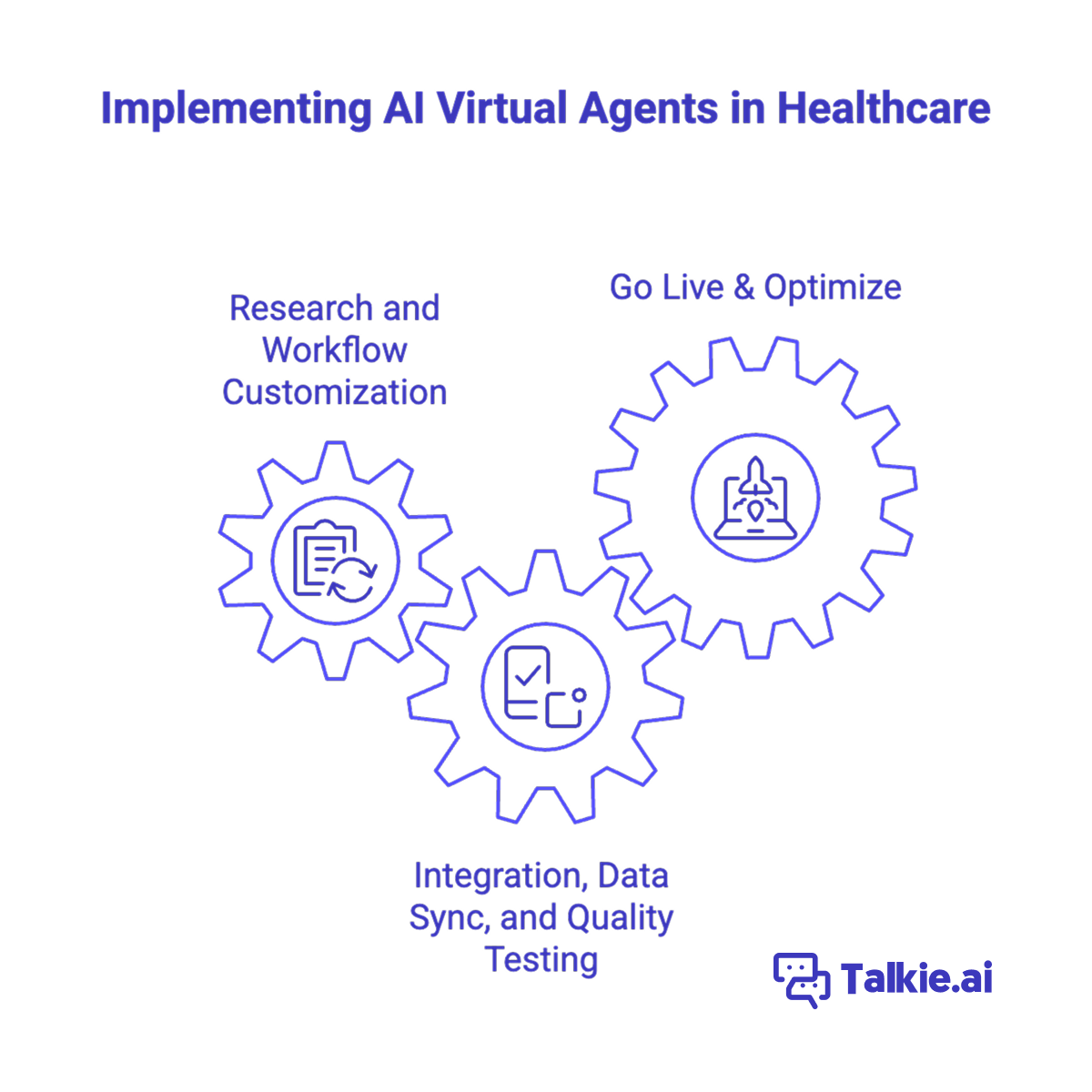
  1. Research and workflow customization. The process begins by understanding your practice’s unique workflows—appointment types, injury assessments, post-surgical follow-ups, acute care, and anything else that fits your specialty. Then it’s time to map out conversation flows tailored to your protocols.
  2. Integration, data sync, and quality testing. Our team connects Talkie.ai with your existing EHR, ensuring that patient data, medication info, and appointment slots remain accurate. Next, we replicate realistic patient calls to test out the agent.
  3. Go live & optimize. Launch your new AI voice agent and monitor performance with real-time analytics. You also receive ongoing support to help you optimize scripts and adapt to evolving clinic needs.

One important thing to note that practice managers often miss: Implementing AI in healthcare can be modular. That means you can start with introducing a single use case, like automating prescription refills. Once you see it benefits your practice, you can add more.

Three interconnected cogwheels labeled: Research and workflow customization, Integration, data sync, and quality testing, Go live and optimize—illustrating the steps to start using AI virtual agents in healthcare.

AI Agents in Healthcare & Data Protection

Security and trust are essential when implementing any AI in healthcare—especially solutions that engage directly with patients. 

A well-designed tool follows non-negotiable security principles, including full HIPAA and SOC 2 compliance, to protect sensitive health information at every step.

Transparency is just as critical. A responsible AI agent never pretends to be human—patients need to be clearly informed who or what they’re interacting with from the start. Otherwise, building confidence and maintaining ethical standards will be impossible.

All conversations and data also need to be handled securely, with encryption and access controls.

These safeguards aren’t optional—if your patients, staff, and physicians will be using a solution, it simply needs to adhere to the highest security standards.

Why You Should Start Small but Start Now with AI Virtual Agents

You don’t need to overhaul everything about your processes to benefit from AI in healthcare

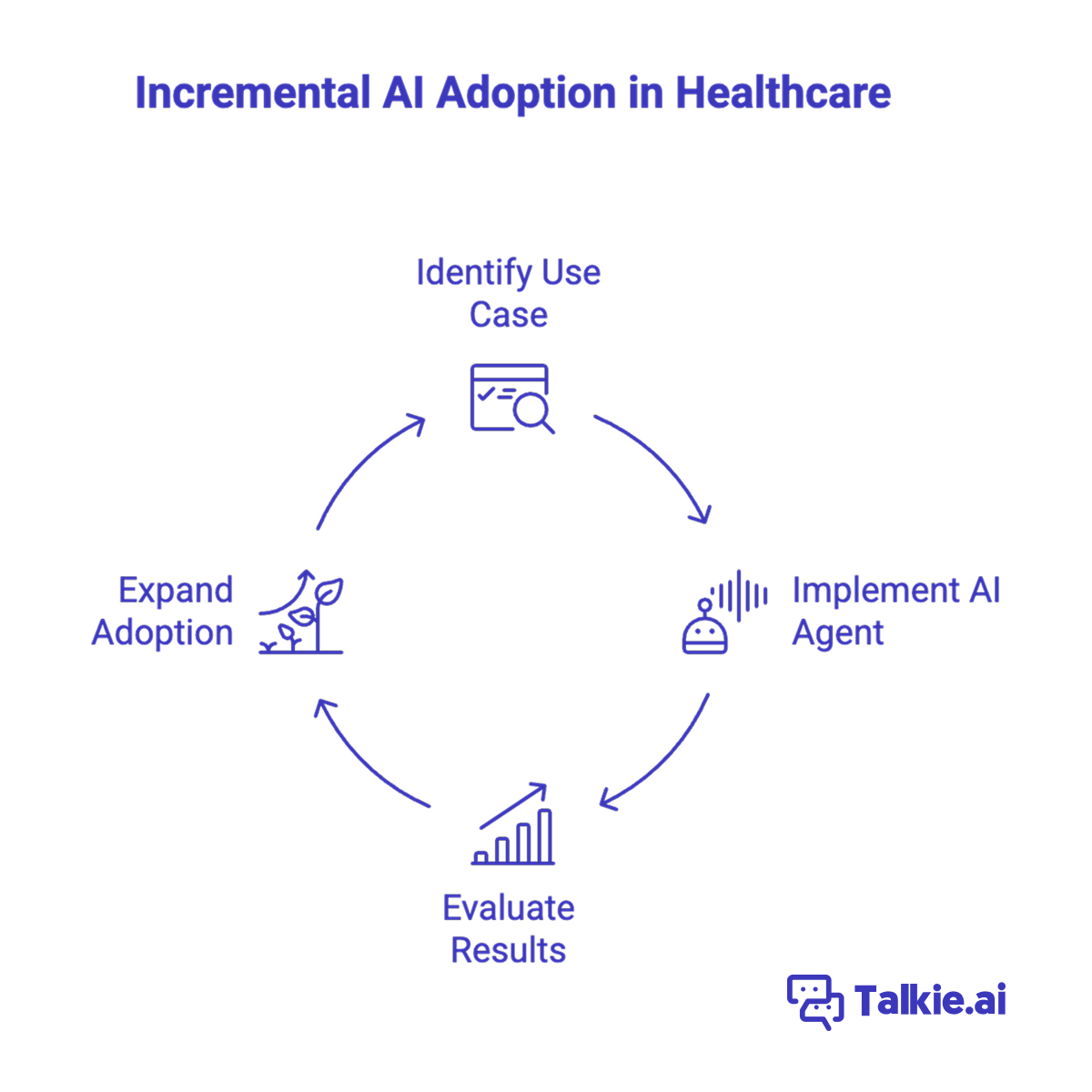
Many clinics begin with one simple use case—then expand once they see results. This kind of incremental adoption allows your team to adapt, learn, and scale once you’re ready.

So how to start incrementally? Here are examples of three processes you can automate first:

  • Prescription refills. Free up your staff by simplifying refill requests.
  • Appointment scheduling. Let patients book, reschedule, or cancel appointments through a conversation with an AI voice agent. You could also start by using the voice agents solely as an after-hours support, or as a secondary response if the human team doesn’t pick up the phone in time.
  • FAQ automation. Use an AI reception system to handle common questions—like opening hours, directions, or insurance coverage.

Starting small helps you move fast—and each process you automate with AI agents in healthcare creates more space for your team to focus on patient care.

Circular infographic titled “Incremental AI Adoption in Healthcare” with four labeled segments: Identify Use Case, Implement AI Agent, Evaluate Results, and Expand Adoption—each accompanied by a relevant icon.

FAQ

  • What’s the difference between a chatbot and an AI virtual agent?

    Chatbots follow scripted paths and handle basic text interactions. AI virtual agents use conversational AI in healthcare settings to understand natural language, manage context, and handle more complex tasks—like scheduling or triaging patient calls. While chatbots are limited to text interactions, virtual agents can do both: tasks that are voice-based and text-based.

  • Do patients know they’re speaking to an AI?

    Yes. A well-designed virtual agent always introduces itself clearly. Transparency is one of the non-negotiable principles every AI company should follow.

  • What if the AI doesn’t understand the patient?

    If the virtual agent can’t confidently handle a request, it escalates the call to a staff member or routes it appropriately—just like a well-trained front desk assistant would.

  • Can voice agents handle more than one call at a time?

    Yes. AI voice agents can manage hundreds of concurrent calls.

Key Takeaways

  • AI virtual agents are advanced, conversational tools designed to handle real patient communication—over the phone or online.
  • They help practices automate repetitive front desk tasks like appointment scheduling, prescription refills, FAQ support, and call routing.
  • Unlike chatbots, these agents use conversational AI in healthcare to hold natural, context-aware conversations.
  • Practices can adopt AI incrementally—starting small, seeing real impact, and scaling over time.
  • Security and trust are built in: HIPAA-compliant, transparent, and already in use at high-performing clinics.
  • The result? Fewer voicemails, shorter wait times, happier patients, and less burnout for your staff.

Ready to discover how AI virtual agents can help your practice?