Conversational AI is a rapidly growing market that is powering automation for a variety of industries and using a wide range of technologies. A recent report estimates that the conversational AI market could exceed US$30 billion globally by 2030.
With so much happening in this exciting field, it’s sometimes hard to keep up with the wide variety of ways people are talking about conversational AI. It can get confusing.
Brush up your knowledge of the growing bank of terminology used to talk about conversational AI with our handy glossary of terms.
artificial intelligence
Commonly abbreviated to AI. This is a general term that refers to a broad set of technologies that allows software and machines to perform ‘human-like’ reasoning and interactions. One of the defining characteristics of AI. is its ability to convince humans that they are interacting with a human-like thinking entity. Another defining characteristic of AI. is its ability to ‘learn’ independently from its initial programming and adapt to new environments.
Related terms
machine learning
AI assistant
AI assistants are software-based services that use some form of artificial intelligence to help automate processes or perform tasks at the request of human users. AI. assistants are a type of virtual assistant. Often an AI assistant will take the form of a voicebot or chatbot to facilitate interaction with human users.
Related terms
virtual assistants, voicebot, chatbot
automatic speech recognition
Automatic speech recognition (ASR) is a software-based service that helps convert pure phonetic input from a human speaker into recognizable words. Speech recognition is often used in conjunction with natural language processing, although speech recognition may be used outside of natural language processing services to power, for example, interactive voice response services where simple voice inputs from humans can be used to navigate a menu system via a telephone.
Related terms
natural language processing, interactive voice response, speech-to-text conversion, voice recognition
chatbot
A chatbot is a software-based service that enables humans to ‘talk’ with a service to either retrieve information or perform a transaction. Typically users interact with the chatbot by typing questions into text interfaces such as an SMS or social media chats or a chatbot on a landing page. A chatbot will use natural language processing to determine what help or information the user needs. Increasingly, chatbots are being distinguished from voicebots although sometimes the two terms are conflated or used interchangeably. Chatbots enable business process automation and are frequently used in contact centers or on social media channels. For more about chatbots, see Toptal’s guide to chatbot terminology.
Related terms
voicebots, natural language processing
conversation design
Conversation design is carried out by a conversation designer when creating a virtual assistant based on voicebot technology. The designer creates a structured conversation for the voicebot to follow to facilitate business automation. The designer also sets up criteria for the voicebot to smoothly handle interruptions and diversions from the scripted conversation by human users. Voicebot AI technology allows the voicebot to maintain a continuous flow of conversation while dealing with various levels of ambiguity that cannot be handled by older forms of automation.
Related terms
voicebots, natural language processing, intent
conversational AI
Conversational AI is a subset of technologies for artificial intelligence. It refers to types of AI software that are designed to handle voice-based interactions with humans, usually using natural language processing and speech recognition and synthesis combined with other automated services. Voicebots typically make use of conversational AI. Siri and Alexa are two widely used examples of voicebots that use conversational AI.
Related terms
natural language processing, speech recognition
conversational IVR
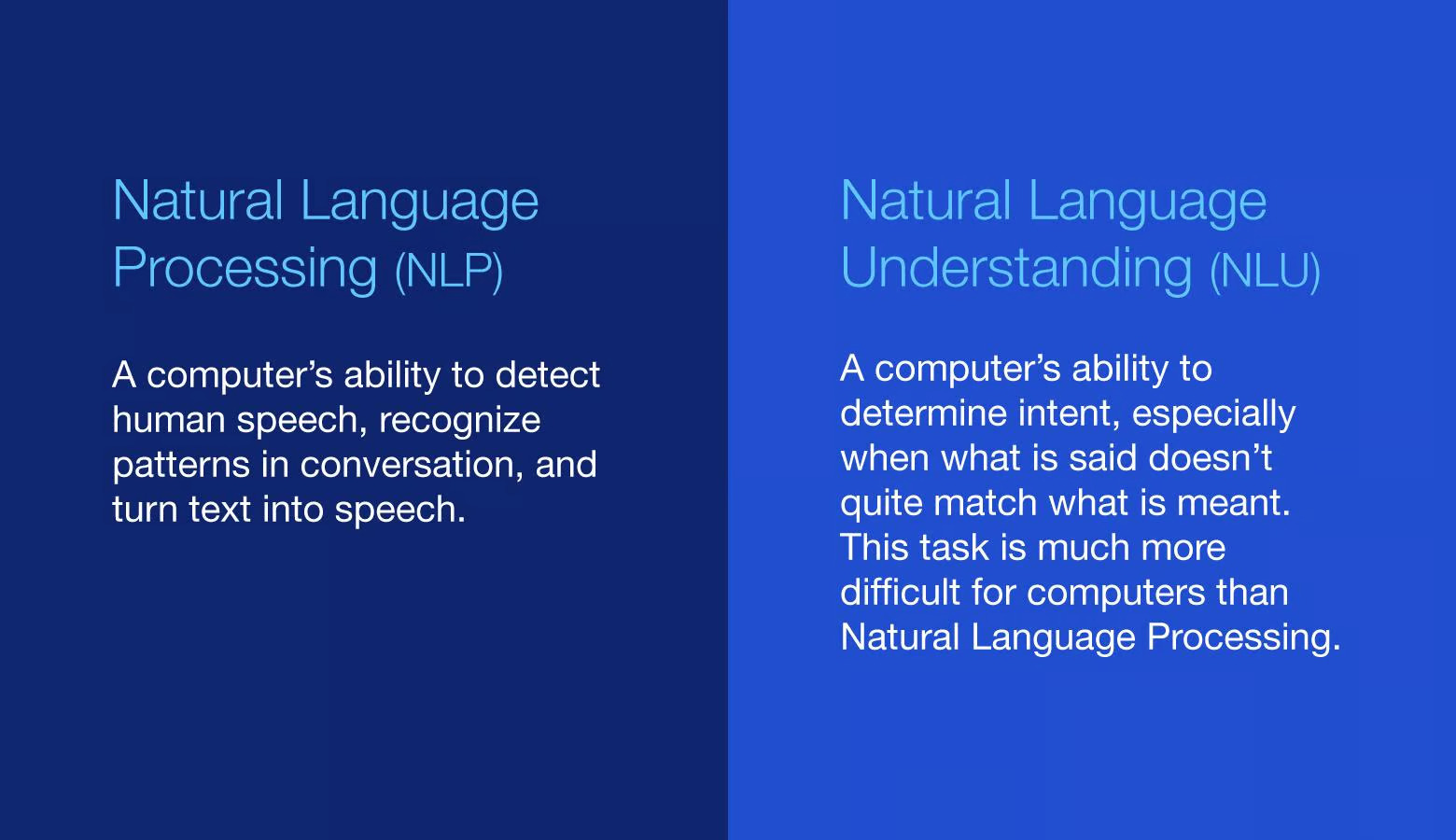
Conversation IVR is a type of conversational AI that uses speech recognition to guide a human user through a branching menu system of information. Instead of requiring users to key a number from their phone dialler interface, conversational IVR allows users to vocalize their selection or response. Whereas traditional IVR systems had speech recognition technology to handle simple voice commands such as “yes” or “no,” conversational IVR allows people to communicate their inquiries in more complete phrases via a natural language understanding
Related terms
conversational AI, speech recognition
customer experience automation
Customer experience automation refers to a set of strategies that a company or business uses to automate interactions with customers. Customer experiences can and frequently do include customer service transactions but also embraces a wider set of considerations for how the brand communicates with customers. Automation can, for example, be used to send messages to customers according to a communications plan or reward customers automatically based on customer behavior records stored in the company’s customer relationship management database (CRM).
Related terms
customer service automation
customer service automation
Customer service automation is a subset of customer experience management. Contact centers will make use of customer service automation to automate certain high frequency, predictable customer interactions to improve access to the service, optimize efficiency or scale customer service levels instead of outsourcing services to a BPO organization.
Related terms
customer service automation
entity
An entity is a key piece of information given by a user when interacting with conversational AI. Named Entity Recognition (NER) along with intent recognition are two of the most important systems used by virtual assistants. It allows a virtual assistant to recognize and capture key information such as times, dates and names that are relevant to completing a transaction or request. For example, if a customer is booking a cab, the virtual assistant will capture the time and location for the cab pickup using NER.
Related terms
intent