







Can AI Scheduling Handle Complex Rules? Absolutely. Here’s What It Needs
Practice managers with complex scheduling rules often wonder if AI scheduling can keep up. It can—here's what's...
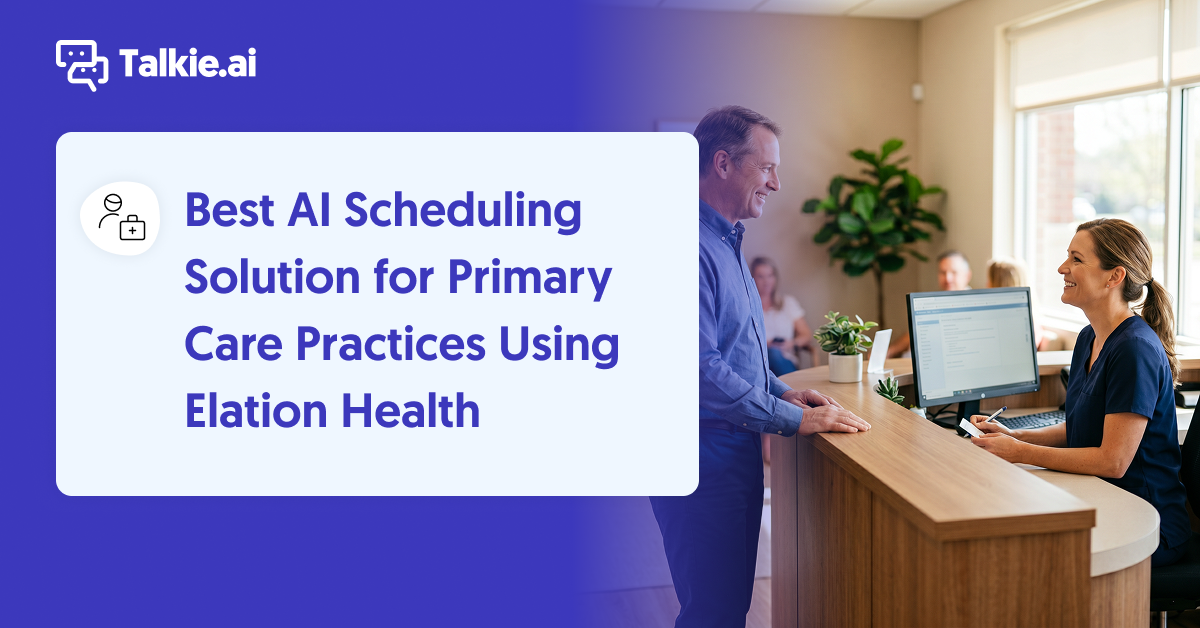
Few specialties ask their scheduling team to cover as much ground as primary care.
A single morning runs through annual physicals, chronic-disease follow-ups, same-day acute concerns, Medicare Annual Wellness Visits, and new patient intakes. Each one calls for a different slot, a different provider, and a different prep flow.
That’s a lot to ask of a phone tree. It’s also a lot to ask of a generic AI receptionist that wasn’t built for primary care complexity.
For practices running on Elation Health, the bar is higher still: the scheduling solution has to flow inside the EHR, not sit next to it.
Talkie was built for both primary care and Elation. The AI agent is trained on primary care workflows—chronic disease management, AWVs, preventive care, acute triage—and integrates natively with Elation Health, where the work has to land.
Primary care isn’t really one kind of practice. It’s a half-dozen kinds of practice sharing one front desk.
In a single morning, a scheduling team will field:
Each one needs a different scheduling decision. Different slot length, different provider, different prep instructions.
Underneath the visit mix is the demographic load. The CDC reports that 3 in 4 American adults live with at least one chronic condition, and more than half live with two or more.
On the supply side, the gap is widening: per HRSA’s HPSA dashboard, about 108 million Americans now live in a designated primary care shortage area, with roughly 18,500 additional primary care practitioners needed to remove those designations.
Demand is rising, the workforce is shrinking, and the complexity of each call isn’t easing up. Scheduling is the choke point—and the place where AI can take the most weight off, if it knows your visit types, your protocols, and your EHR.
Two AI agents could both technically “integrate with Elation.” They could each connect to the API and push data over. They wouldn’t both work the same way.
A shallow integration—where the AI sits next to Elation rather than inside it—leaves your team with a lot of work. Appointment requests arrive as separate notes. Refill conversations need manual entry. Patient details get re-keyed.
A deep integration works differently. The AI agent works inside Elation. Appointments land directly on the provider calendar. Refill requests flow to the right queue. Patient conversations are documented as message threads in the chart, where the provider expects them.
That’s the difference between automation that helps and automation that creates new manual work.
Talkie has the deepest Elation integration on the market—and is listed on the Elation Marketplace, having gone through Elation’s full vendor evaluation.

Here’s what Talkie handles for a primary care practice—all of it landing in Elation:
Below are three demos showing how everyday primary care calls flow into Elation.
📺 Scheduling a primary care visit. A patient calls to book—Talkie verifies them, finds a slot that fits their visit type, and books it in Elation. Watch the demo →
📺 Prescription refill request. Talkie collects medication details, verifies the patient, and logs the request inside Elation for the provider. Watch the demo →
📺 A Spanish-speaking patient requesting a referral. The AI agent handles the full conversation in Spanish—and the referral request lands in Elation in English, ready for the team. Watch the demo →
Want to see more? Watch the full playlist of Talkie + Elation demos →
Family Medicine Clinic is a 2-location primary care practice in Washington serving a diverse patient base—about 40% of their patients speak Korean. With a small staff, simultaneous calls and language barriers were creating long wait times and missed opportunities. Adding more people wasn’t the answer; the practice didn’t have the budget for it.

Before using Talkie we had difficulty keeping up pace with multiple calls coming at the same time. I just don’t have enough staff to be able to answer the phone calls and serve all my patients appropriately.

The clinic’s AI agent, “Rachel,” went live in August 2025, fully integrated with Elation. Rachel handles multiple simultaneous conversations in English and Korean, around the clock.
What changed:
Talkie also surprised me because I did not anticipate that my older patients, the ones in their 60s and mid 60s, would actually use the AI to schedule appointments. I started to see a lot more on the schedule saying Talkie.ai is scheduling patients that are in their mid 60s.
On the question that drove the decision in the first place, call volume, Dr. Leng’s verdict is just as direct:
For all of my staff to be able to handle 100 calls a day, it’s impossible. But with Talkie.ai—not a problem at all.
Black Bear Primary Care, also running on Elation, has seen the same shift. Here’s how their physician describes it:

The solution provides clear operational value, especially in streamlining workflows and capturing patient information within our EHR… [Talkie’s] collaborative, flexible, and proactive approach has made them a strong partner in adapting the solution to our practice’s needs.

🎙️ Related listening
We had Fareed Taghvaee, Senior Director of Partnerships at Elation, on the Scaling Practice Management podcast—talking through the operational challenges primary care navigates: credentialing, billing, denials, and KPIs that move the needle.
Earthquakes, EHRs, and the Complex World of Medical Billing in Primary Care →
Primary care practices on Elation are adopting AI scheduling already. The longer you wait, the further along they pull.
Or as one Practice Administrator put it:
AI is new, it’s the wave of the future, so we could either wait and implement it later and be behind the technology bubble, or we can be ahead of the technology bubble. I prefer to be ahead rather than behind.
We’ll show you exactly what Talkie looks like in your practice’s workflow—how scheduling, refills, and message threads land in Elation, and what changes for the people on the phones.
Built for primary care. Built for Elation Health.
See what Talkie can do for your practice.
How deep is Talkie’s Elation integration?
Talkie has the deepest Elation integration on the market and is listed on the Elation Marketplace. Scheduling, prescription refill requests, message threads, new patient charts, and call routing all happen directly inside Elation. See more demos of Talkie in Elation →
What primary care-specific tasks can Talkie handle?
Talkie’s AI agents are trained for primary care workflows—annual wellness visits, Medicare AWVs, chronic disease management, acute concerns, preventive screenings, and the most common primary care refills. Visit this page for our full list of primary care capabilities.
Does Talkie work for non-English-speaking patients?
Yes. Talkie handles multiple languages—English, Spanish, Korean, and others. At Family Medicine Clinic, 40% of patients speak Korean, and Rachel takes those calls in Korean.
What happens if a patient needs to speak with someone on the team?
Talkie routes urgent or complex calls to the right person, with full context from the conversation already captured. The patient doesn’t have to start over.
Is Talkie HIPAA compliant?
Yes. Talkie is HIPAA compliant and SOC 2 Type II certified.
Practice managers with complex scheduling rules often wonder if AI scheduling can keep up. It can—here's what's...

Explore the differences between the three types of EHR integrations, and find out how each impacts AI agents in...