







AI-to-Human Handoff, Explained: How AI Agents and Staff Share the Phone
Not every call can be resolved by AI—and that's by design. Learn how AI-to-human handoffs keep every patient call moving...
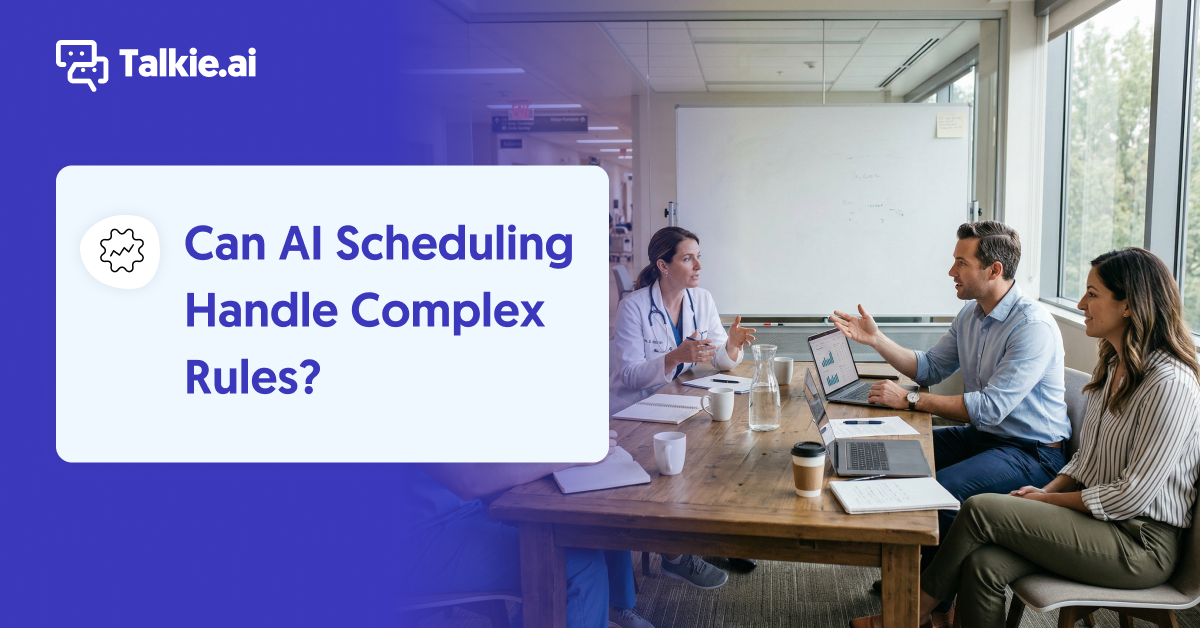
There’s something practice managers say in almost every conversation about AI scheduling, usually within the first few minutes: “This sounds great, but our scheduling rules are really complex.“
They’re usually right. The rules genuinely are complex. There are many variables in play—patient demographics, insurance, provider sub-specialisations, visit types, referral requirements, slot negotiation logic—and how differently each practice combines them.
The good news is that a well-configured AI scheduling system can handle all of it. But before it can, those rules need to be clearly defined. And in many practices, that’s the first real step—because the rules live in people’s heads, split across the front desk team, rather than in any document. Getting them out, structured, and agreed upon is what makes everything else possible.
This article walks through exactly what “complex scheduling rules” means in practice, what variables are involved, and what an AI system needs in order to handle them reliably.
If you manage a practice with complex scheduling rules and you’re wondering whether AI can keep up—this article is for you.
Topics like this one come up a lot on our podcast, Scaling Practice Management
built for practice managers who want honest conversations about operations, technology, and growth.
When a practice manager says their scheduling rules are complex, what they’re describing is the decision-making process a front desk receptionist runs through every time a patient calls. The question being answered, every single time, is: what is the right appointment type, with the right provider, at the right location, for the right duration—for this specific patient and this specific issue?
In a well-run practice, those rules exist somewhere. But where that is, varies from practice to practice.
Sometimes they’re written down, consistently applied, and easy to hand off. More often, they’re in someone’s head—or split between multiple people’s heads, with subtle differences that nobody has noticed yet.
When a practice starts working through their scheduling rules with Talkie’s implementation team, it’s not uncommon to discover that the front desk team and the practice manager have slightly different understandings of the same rule.
Getting those rules out of people’s heads and into a documented, structured format is the foundational step. Without it, there’s nothing for an AI—or anyone else—to reliably follow.
Before a single appointment slot gets offered, a lot of decisions have already been made based on who the patient is. The factors that shape scheduling decisions on the patient side include:
Each of these variables can change the outcome. Often it’s a combination of two or three of them together that determines the path.
Once it’s clear who the patient is, the next layer is the visit itself. What’s the issue, and what do we know about it? Consider:
Matching a patient to a provider isn’t just about availability. It involves a set of criteria that has to be checked on the provider side too. The main variables are:
This is the matching layer—where what the patient needs gets mapped against what a specific provider can offer.
Even after the right provider and appointment type have been identified, there’s still the question of when.
Practices handle this differently. Some always lead with the first available slot. Others ask the patient for their preference first. Both are valid—but the AI needs to know which approach a given practice uses.
From there, slot negotiation can get quite dynamic:
At Talkie, the slot negotiation process is built to handle exactly this kind of back-and-forth. The patient can change providers, change locations, or search across different combinations—and the AI adapts based on what the patient says, not on a fixed decision tree.
There’s an assumption that small practices have simpler scheduling rules. That’s often not the case.
Small practices tend to have fewer structured processes and more exceptions. Rules that have never needed to be written down because the same two people have always handled them. Workarounds that have been in place so long they’ve become the rule. A solo provider who has very specific preferences that live in their head and haven’t been communicated to anyone else.
Practice size doesn’t determine rule complexity. The degree to which rules have been documented and standardized does.
A generic scheduling tool—or a standard online booking portal—can’t account for this level of nuance. This is a big part of why patient portals often sit unused, even when they’re included as part of a practice’s existing software package. They’re built for the straightforward case, and the straightforward case is rarely who actually walks through the door.
What works is an AI scheduling system that has been configured around each practice’s specific rules—and an implementation process designed to surface those rules before go-live.
That’s how Talkie approaches every new practice. Before the AI handles a single call, Talkie’s team works through the full set of scheduling rules with the practice: patient variables, visit variables, provider criteria, slot negotiation logic. If the rules aren’t documented yet, that process becomes the documentation exercise. If there are inconsistencies between what different team members think the rules are, those get resolved.
There’s also the EHR layer to consider. Every clinic’s scheduling template is different. Some use generic appointment types; some use highly specific ones. In athenahealth, for example, a practice might use a generic appointment type during the scheduling conversation and then overwrite it with the specific type they actually want—and the AI has to handle that translation.
Talkie’s deep native integrations with athenahealth, ModMed EMA, Elation Health, AdvancedMD, and eMedicalPractice mean the scheduling logic can reflect the way each practice’s EHR is actually set up, not a one-size-fits-all approximation.
The question worth asking isn’t “are our rules too complex for AI scheduling?” It’s “have we ever actually written our rules down?“
For many practices, the implementation process is the first time that’s happened. And the value of doing it extends beyond the AI—it creates clarity for new hires, reduces inconsistency across the front desk team, and gives practice managers a cleaner view of how scheduling decisions are actually being made.
The complexity of your rules isn’t a reason to hold off on AI scheduling. It’s the reason to choose an AI scheduling solution that treats configuration as a core part of what it does—not an afterthought.
That’s the work Talkie does with every practice before go-live. Because no two practices schedule the same way, and a system that doesn’t account for that isn’t really solving the problem.
Can AI scheduling really handle complex medical scheduling rules?
Yes. A well-built AI scheduling system can handle patient demographics, insurance matching, provider sub-specialization, visit type logic, and dynamic slot negotiation. What it can’t do is invent rules that haven’t been defined. The AI is only as good as the logic it’s been given. That’s why the rule-mapping exercise before go-live matters as much as the technology itself.
What if our scheduling rules aren’t written down yet?
That’s more common than most practices realize, and it’s not a blocker. Talkie’s implementation team works with practices to extract those rules during onboarding—mapping provider preferences, visit logic, and patient eligibility criteria into the AI’s decision tree.
How does AI scheduling connect to our EHR?
It depends on the depth of the integration. Talkie offers deep, native integrations with athenahealth, ModMed EMA, Elation Health, and eMedicalPractice—meaning appointments land directly in the EHR in real time, with no manual data entry and no risk of double-booking, because the AI is reading live availability. Talkie queries your actual appointment types in real time, so if a new patient visit requires 40 minutes and a follow-up requires 15, the AI identifies the patient status and pulls only the slots that match—not a fixed generic slot.
What happens when a patient’s situation doesn’t fit a standard scheduling path?
Talkie is built around what we call safe automation. If a patient’s request falls outside the rules that have been programmed—an unusual procedure, an emergency, or a situation that genuinely needs human judgement—the AI performs a warm transfer to the front desk. The staff member receives a brief summary of the conversation so they’re not starting from scratch.
Does Talkie replace our existing patient portal?
No. Think of Talkie as an additional layer that sits alongside your portal. Many patients prefer self-service online booking, but a large share still pick up the phone—and those callers deserve the same seamless experience as digital users. Talkie handles that call volume without adding to your front desk’s workload.
How long does it take to teach the AI our practice’s specific rules?
Because Talkie specializes in athenahealth, ModMed EMA, Elation Health, and eMedicalPractice, the team isn’t starting from zero. A typical implementation takes four to six weeks. During that time, Talkie’s experts work with your practice manager to extract the rules from your team and codify them into the AI’s logic—covering everything from provider preferences to patient eligibility criteria to slot negotiation behavior.
The best way to know whether AI scheduling can handle your rules is to walk through them with us
Not every call can be resolved by AI—and that's by design. Learn how AI-to-human handoffs keep every patient call moving...
Everything you need to know about AI front desk agents for healthcare practices. Learn about features, ROI, and implementation...