But that’s changing. AI voice agents are more and more often assisting the overwhelmed front desk teams, taking on routine tasks and streamlining patient communication.
In this article, we’ll explore how AI voice agents are a game-changer for medical front desk productivity.
What are AI voice agents?
AI voice agents are AI-powered software programs that can interact with users via phone, using natural language, such as English or Spanish. They can understand what the person they’re speaking to is asking them to do and perform the requested task. Essentially, they augment human front desk teams and help them manage the workload.
How are AI voice agents supporting the healthcare front desk?
In the healthcare setting, AI voice agents can pick up the patient calls and help the front desk staff out with a variety of tasks, such as scheduling appointments, answering frequently asked questions, and managing prescription refills.
Crucially, voice assistants are not limited to basic responses. They can also process complex inquiries, route calls to the appropriate department, and even update patient records in the practice’s Electronic Health Record (EHR) system. That’s what makes them significantly stand out from more simplistic solutions, like IVR.
Key benefits of AI voice agents for front desk productivity
The sheer amount of work that lands on front desk teams leads to high levels of stress and reduced productivity.
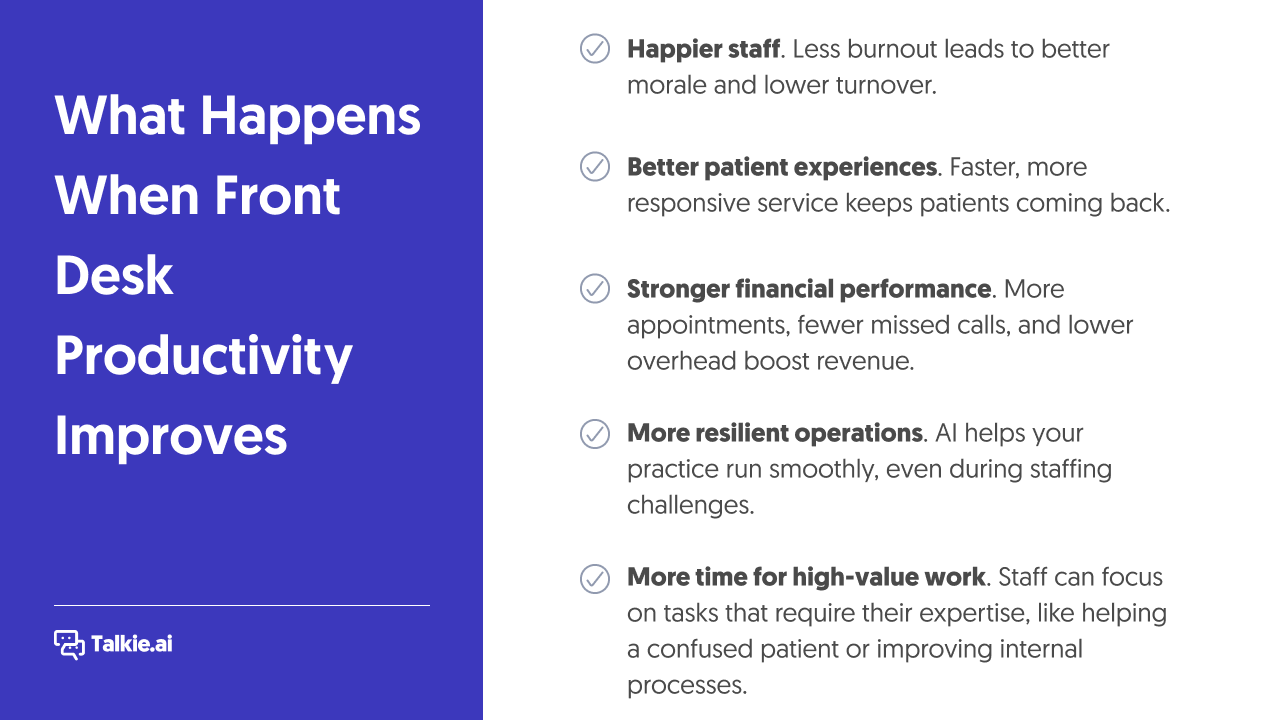
AI voice agents can tackle both of these problems by automating routine calls, streamlining workflows, and freeing up staff to focus on higher-value tasks.
Below are the key ways AI can boost front desk efficiency, allowing your team to handle more in less time—without sacrificing patient satisfaction.
- Instant call answering: Nobody likes waiting for their call to be answered. AI voice agents do away with this issue not just by reducing wait times, but rather eliminating them completely. When patients contact the practice, their calls are immediately picked up and their inquiries are handled right away.
- Reduced staff workload: One of the key ways AI voice agents enhance productivity is by automating a big chunk of routine calls that often consume valuable staff time, like patients calling to ask about opening hours or parking. This not only increases productivity but also reduces staff burnout.
- Multitasking capabilities: A human can only handle one call at a time with proper focus. AI voice agents can run a virtually unlimited number of calls at the same time—perfectly addressing the problem of the Monday morning rush. This way, your practice can maintain high call volume without sacrificing response time and frustrating your patients.
Together, these features dramatically improve front desk productivity.
But AI voice agents actually deliver a double boost.
Not only are they highly efficient on their own, handling thousands of calls simultaneously with zero wait time, but they also empower your human staff to be more productive.
By offloading routine and repetitive tasks, your team gains the time and headspace to focus on work where their expertise is essential—like helping new patients, managing complex cases, and delivering exceptional care.