








7 Reasons Why Medical Practices are Turning Toward AI Front Desk Agents
Seven common reasons why medical practices adopt AI—from tackling high call volume, reducing staff burnout, and helping practices...
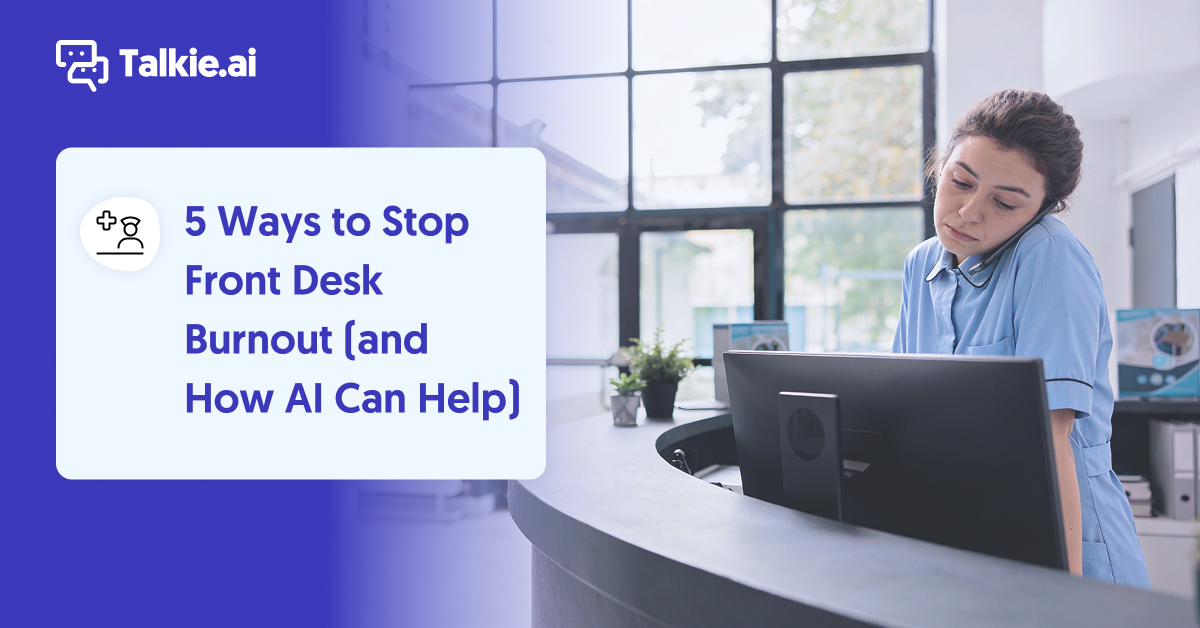
It’s 2 PM on a Tuesday. The phone has rung 47 times in the last hour. Five patients are waiting in the corridor. The printer is jammed. And your best receptionist just texted that she’s “thinking about other opportunities.”
When most people hear about burnout in healthcare, they typically think of doctors and nurses—the frontline workers who are directly involved in patient care. And this concern is absolutely valid; the pressures they face are immense.
However, there’s a critical group often overlooked in the conversation: front desk workers. These individuals, who are often the first point of contact for patients, bear a significant amount of stress as well.
In fact, a recent survey by MGMA found that 64% of medical groups report that staff turnover was the same or higher in 2025 compared to 2024—and they pointed to medical assistants and front office staff as the positions experiencing the highest churn.
To better understand this trend, we’ve drawn expert insights from the Scaling Practice Management podcast.
In this article, we’ll look at 5 of the reasons for burnout and turnover in front desk healthcare staff, and provide solutions to address them.
Front desk workers frequently deal with an overwhelming amount of responsibilities, from managing patient records and answering phone calls to scheduling appointments and dealing with insurance claims. As patient demand rises, so does the workload, leading to fatigue, frustration, and eventually burnout.
Additionally, when the front desk is tied to the phone, critical administrative documentation and back-office tasks often fall by the wayside, creating a backlog that haunts the staff.
One of our podcast guests, Tiffany Burke, highlights how automation allows for the “reutilization” of staff to clear these backlogs:
“[AI agents] take a lot of the burden off of specifically the front desk and the admin teams. And it opens up a spot for them to be able to actually get other things done.”
“Now that I no longer have to have my front desk person answering the phone all the time, I can use that person to supplement and take care of the documentation that’s been stacking up for months that I need to get out the door. So I think that’s a good way of re-utilizing. It’s actually like looking at my office and seeing, where am I weak at?
And now that I’m stronger at my front desk, can I take those people and put them in this spot where we haven’t been thriving as much so that we can get this area moving and going to the success that we now have at the front desk.”
Tiffany Burke
Independent consultant, athenahealth expert
By automating phone calls, practices provide immediate relief to their team by removing the constant, jarring interruptions of a ringing line. This allows leadership to pivot talent toward high-value documentation and patient-follow-up tasks that have been “stacking up for months.”
Introducing AI agents that are natively integrated with your EHR (e.g with athenaOne or ModMed EMA) brings an additional benefit: if the AI handles data entry and schedules appointments directly in the system, it eliminates the repetitive manual labor that fuels burnout. When the backlog is cleared and the mechanical work is automated, staff can finally focus on the one or two core tasks that actually require human judgment, leaving them feeling accomplished rather than perpetually behind.

Over the last month, Talkie’s handled over 6,000 phone calls. They work with our workflow; we don’t have to conform to theirs. The other day, I walked out with the phone supervisor at 5:05, and they were just like, ‘Oh my gosh, we never get out of here close to 5. We’re usually out of here around 6.’ So they were all smiles. The Talkie team wants you to succeed, and they do whatever they can to make sure the implementation is successful.
Managing frustrated patients who’ve been waiting too long is one of the hardest parts of front desk work. Whether patients are waiting on the phone or in the lobby, their frustration adds to the stress for front desk staff who are already juggling multiple tasks and constantly playing catch-up. Even your best medical receptionists can become flustered when annoyed patients blame them for something beyond their control.
We talked with Angela Presley in one of our first episodes of Scaling Practice Management. During our conversation, she highlighted why patient experience is so critical to staff wellbeing:
Very often we are interacting with people who are already having a bad day. You know, they’re sick, they’re hurt, they’re not at their best, and that’s why they’re coming to see us. And so we have to be at our best to be able to kind of compensate for that in order to meet in the middle and have it not be like a volatile situation. Otherwise you end up with frustrated patients and frustrated staff and that combination just can be really toxic.
Angela Presley
Program Manager for Healthcare Accelerators at Dartmouth
But how can staff “be at their best” when they’re already facing more work than they can handle?
What if patients could get their cases addressed without waiting, so they’re less frustrated by the time they interact with human staff?
AI-powered assistants like Talkie.ai can immediately address patient needs, from appointment scheduling and confirmation to processing prescription refill requests and answering frequently asked questions.
By removing the ringing phone from the equation, your staff can focus on complex cases that truly need human empathy, rather than burning out on repetitive inquiries while an increasingly impatient queue builds up.
Communication breakdowns between departments—whether it’s between the front office, clinical teams, or administrative staff—lead to “investigative” work that eats up hours of the day. Without a shared “point of connection,” departments often operate in silos, unaware of how their small errors create massive downstream failures.
In her podcast episode, Christina King emphasized that cross-functional communication is the only way to stop recurring errors:
You’ve got teams and they’ve got to be cross-functional. They’ve got to work well and communicate well with each other. We’ve got to have points of connection, right? We’ve got to have those meetings. I know people hate meetings, but meetings do serve a purpose because it’s required that we communicate with each other. If we see a trend with claims denying, we can track that back to what’s causing it. And if it is “member not found” in a denial for a claim, and we see there is a problem with how we are gathering data for our insurances, we can track that back to who’s gathering that data. Is that our front desk? What are our points of failure here?
Christina King
Vice President of Revenue Cycle Operations at Nevada Heart and Vascular Center
Solving communication breakdowns requires commitment from leadership. First, prioritize regular cross-functional meetings where teams can review “points of failure” without blame. Make these meetings structured: identify the pattern (claims denying for “member not found”), trace it back to the source (front desk data entry), and implement a fix.
Second, reduce human error at the data entry stage. AI agents can capture patient data with high precision, automatically updating the EHR with accurate insurance information, patient contact details, and appointment notes. For example, when an AI agent schedules an appointment, it can verify insurance eligibility in real-time and flag any coverage issues. This means your cross-functional meetings can focus on strategy and improvement rather than constantly troubleshooting preventable mistakes.
High turnover is often the result of staff feeling that their professional life has become a series of automated tasks, leading them to “clock out” mentally long before they leave the job.
Another of our guests, Nacole Hodge, works with healthcare professionals struggling with burnout. In her episode, she describes a deeper crisis: the person behind the professional feels disconnected and loses their identity. The daily grind of policies, procedures, and numbers buries the passion that brought them to healthcare in the first place:
“I help healthcare professionals that are struggling with that silent burnout. The loss of their identity personally—they lose that again behind that badge. There’s a crisis where the person behind the professional feels disconnected, undervalued in some areas.”
“I think the passion just gets lost because of all the policies, the procedures, the numbers, and also the shortage in staff from all aspects of the healthcare field.”
Nacole Hodge
Independent Epic consultant and career coach
She explains how this disconnect manifests as a survival mechanism—staff build emotional walls to cope with the relentless workload:
When we’re taking each situation to the next situation or to the next patient, we tend to say, okay, I’ve got to put up a barrier. I can’t continue to carry on. I can’t continue to carry all of this burden anymore. And so now I’m putting up the wall so that way it doesn’t come into me. And then now our empathy is gone. So taking it one patient at a time, instead of starting your day out, looking at your schedule going, oh my goodness, I’m 10 patients overbooked… Now you’ve already put that stress on yourself and now the wall, before you even walk into your first patient, that wall is already built now.
Nacole Hodge
Independent Epic consultant and career coach
This dynamic affects both clinical professionals and front desk staff. While nurses and doctors may build walls patient-by-patient, front desk workers build them call-by-call, complaint-by-complaint.
When staff enter the day already defeated by an overwhelming schedule, and when they’ve built walls to protect themselves from the burden, their empathy—and their reason for being in healthcare—disappears. This is the silent killer of retention.
Create space for your staff to reconnect with the purpose that brought them to healthcare. This means:
When people can take each patient “one at a time” with genuine presence instead of starting the day already overwhelmed, and they feel supported by the team they know well, they are far more likely to stay.
Finally, scaling a practice requires the courage to protect your environment from what we might call “culture blight.” When 20% of your team is disengaged or problematic, the other 80% picks up the slack—and they burn out faster.
Good employees don’t just do their own jobs when toxic colleagues underperform; they absorb the extra phone calls, smooth over the mistakes, and apologize to frustrated patients on behalf of team members who don’t care. This “invisible overtime” is a silent killer of morale and a fast track to losing your best people.
Tiffany Burke also argues that leaders must be willing to make hard decisions to protect the 80% of their team who are truly invested:
The Pareto rule talks about an 80/20 curve of when you’re in a culture or you’re in an environment, 80% of the office is gonna adopt and go along, but then you’re gonna have the 20% that are the problematic individuals. And generally those people, and I hate to say this, but they are a blight on the culture of the office and they have to be removed.
Tiffany Burke
Independent consultant, athenahealth expert
Practice managers must shift to a “protecting culture” mindset. The fear of letting go of underperformers often comes down to one question: “Who will answer the phones?”
Use technology to remove this barrier. When AI handles the baseline workload—answering calls, scheduling appointments, processing routine requests—you can afford to make personnel decisions based on culture fit. You’ll never feel forced to keep a toxic employee just to keep the lights on.
But technology alone won’t fix a culture problem. You also need to:
Front desk burnout isn’t inevitable. It’s the result of specific, identifiable problems—and each one has a solution.
Some of these solutions involve AI technology that can lift the administrative burden and eliminate the mechanical work that buries your staff. Others require leadership commitment to create connection, protect culture, and help your team reconnect with their purpose.
The practices that will thrive in the next decade are those that use innovation not to replace their people, but to protect them.
Start by identifying which of these five drivers is hitting your practice hardest. Is it the phone ringing off the hook? The communication gaps? The talent walking out the door? Then explore AI solutions that target that specific pain point.
The goal isn’t to automate everything—it’s to remove the obstacles that prevent your people from doing what they do best: caring for patients.
Subscribe to our podcast for more conversations on scaling practices
Seven common reasons why medical practices adopt AI—from tackling high call volume, reducing staff burnout, and helping practices...
Looking to add an AI assistant to your medical practice? This buyer’s guide outlines key questions to ask vendors before making a...