







Patient Experience in Healthcare: The Simple Improvements That Make a Big Impact
Learn what patient experience means in healthcare and how AI tools like conversational agents can help improve...

When patients call your practice, that’s a sign of success. It means they either already trust your providers, someone whose opinion they value recommended you to them, or they were convinced by the positive reviews they found online.
The issue is, this success can easily turn into failure when the call volume becomes overwhelming.
If patients can’t get through, satisfaction drops, staff becomes overworked, and revenue opportunities are lost.
In this article, we’ll take a closer look at the challenges that come with high call volume and several ways to fix them.
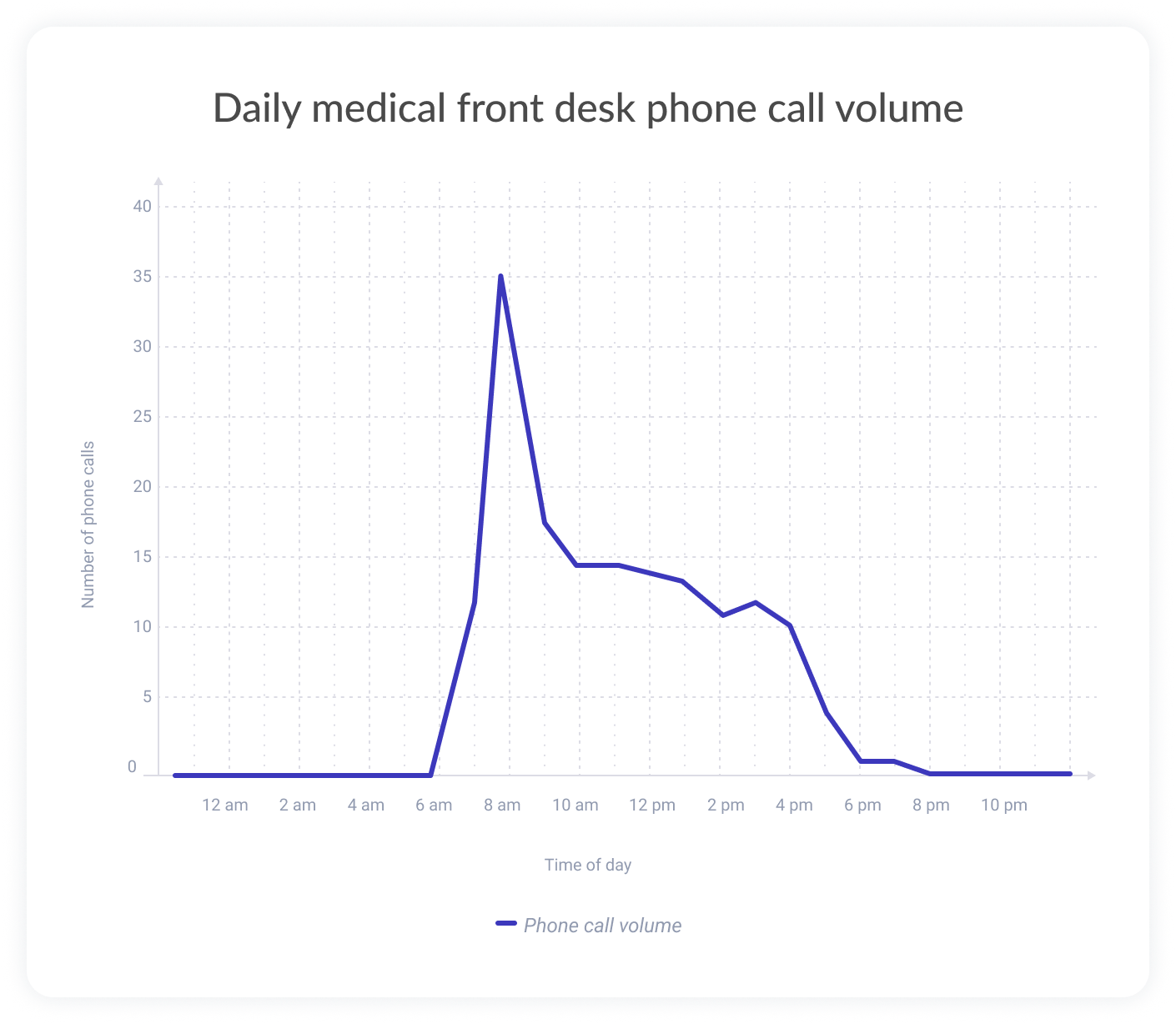
In many practices, phones start ringing before the doors even open. Then by 8 or 9 AM, the phone calls reach peak time. Mondays, lunch hours, flu season, and back-to-school periods all compound the pressure.
The relentless call volume creates real risk.
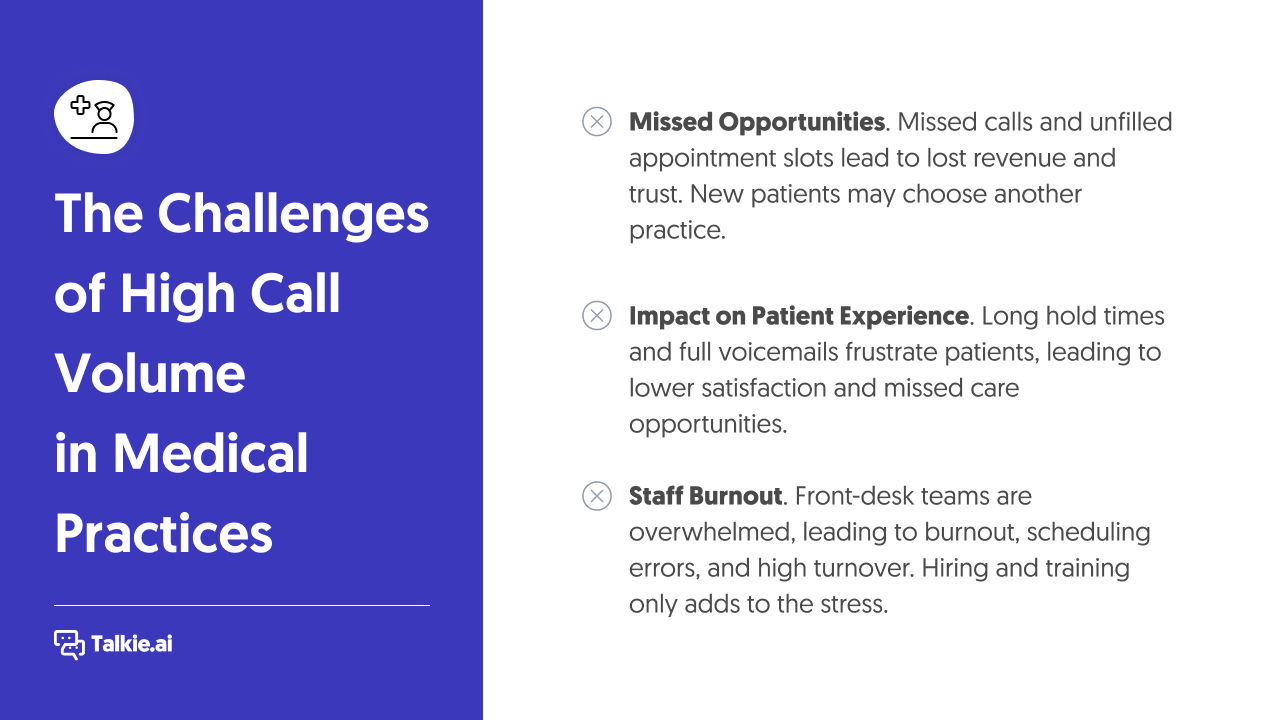
That results in lost revenue, lost trust, and missed opportunities to deliver care.
Patients on the other end of the line feel it too. Long hold times and full voicemails send a clear message: “We’re too busy for you right now.”
A poor experience leaves patients frustrated and anxious—and that drives satisfaction scores down.
Then there’s the toll on staff.
In the long run, the pressure has a negative impact on staff morale, energy, and focus.
When practices become aware of these challenges, naturally they come up with ways to fix them. But quite often the fixes can turn out to be too costly, or too inefficient.
Adding headcount might seem like the most direct path to fixing the problem.
But not only is hiring expensive and time-consuming—it also won’t necessarily solve anything.
One person can successfully carry out a single conversation at once. That’s not enough when multiple patients are trying to reach your practice at the same time.
Additionally, high turnover among administrative staff means the cycle of hiring and training never truly ends.
Patient portals can be helpful, but adoption varies widely, especially among older patients or those with limited digital access.
More importantly, portals don’t help when patients are anxious, have urgent questions, or simply prefer to speak instead of type.
Online patient portals also do nothing to reduce overflow when phones are already ringing.
Some practices turn to third-party call centers for additional headcount.
While these may offer some respite, they come with trade-offs, like inconsistent patient experience due to frequent staff rotation.
Without deep knowledge of your workflows or patients, outsourced teams often struggle to deliver the level of service your front desk is known for.
Traditional IVRs (press 1 for this, press 2 for that…) are frustrating and often ineffective.
Patients get lost in menus, reach the wrong department, or simply hang up in hopes of receiving better assistance if they call back later.
If all of these solutions aren’t good enough, what is?
A truly good solution would combine the flexibility and intelligence of human staff with the scalability of automation, while maintaining high standards of patient experience and adhering to your practice’s workflows.
That’s exactly how AI agents operate.
Would your practice benefit from AI front desk agents?
The options listed above either expect practices to:
The best solution will do neither—and that’s what you get with AI voice agents.
If you’ve spoken with robots on the phone before you might have mixed feelings. The thing is, AI voice agents are more than bots. They can understand the patient, ask follow up questions, and grasp complex messages like “I need a check-up but I can only do Thursday afternoons.”
Here’s an example of AI’s interaction with a caller.
Make sure your patients can book a visit with their provider with a simple phone call, regardless of how busy your front desk team is when they reach out.
When a modern AI agent picks up the call, the patient gets a quality of service comparable to speaking with a human, while the practice doesn’t have to manage additional people.
That’s because the AI agent has access to the same information your staff has access to, speaks with a human-like voice, and answers calls instantly.
Here are some of the strengths of AI voice agents—based on what our agents at Talkie can do:
Every call is answered immediately. Talkie’s AI greets each caller the moment they reach out to your practice, eliminating both the frustration of long hold times and the risk of abandoned calls.
Our voice agents manage unlimited concurrent calls, ensuring no patient is ever turned away, put on hold, or dropped.
Talkie handles the repetitive calls that take up a lot of your staff’s time, like scheduling visits, prescription refills, or answering frequently asked questions. It works just like your front desk team would—except it can talk to countless patients at the same time.
Not every call can—or should—be handled by automation. In such cases, Talkie seamlessly routes the call to the right person or department based on your practice’s rules and workflows.
Patients don’t necessarily stop calling at 5 PM. For some, that’s the first moment in their busy schedule when they can contact your practice.
With 24/7 availability, Talkie ensures your patients always have access to support, even during evenings, weekends, or holidays.
After-hours support is also a great feature to introduce first—it helps your team right away while allowing you to test the solution without fully overhauling your current workflows.
From pediatrics and OB-GYN to dermatology and orthopedics, Talkie isn’t a one-size-fits-all system. Our AI voice agents are trained to handle the terminology, workflows, and patient needs unique to your specialty, ensuring accurate, efficient, and patient-friendly interactions every time.
Subscribe to our newsletter and get access to the Talkie Educational Vault
A collection of articles, videos, and podcasts made to help practice managers succeed
Introducing AI to patient communication can feel like a fad, but it’s not. Despite being a new technology, it offers a significant advantage, especially to practices who are willing to adopt it now.
You will set your team up for relief from the pressure of high call volume—and you set your patients up for a better experience from the very first ring.
The benefits are immediate:
That said, you don’t have to transform everything all at once. Start small. Use AI voice agents to cover overflow calls, or provide support on weekends and holidays when your staff is not available.
From there, you can scale at your own pace, knowing every step brings you closer to less burnout, smoother workflows, and stronger patient satisfaction.
Find out which calls at your practice could be handled by AI voice agents

Learn what patient experience means in healthcare and how AI tools like conversational agents can help improve...

Discover why specialty-focused voice AI is the best choice for your medical practice, ensuring smooth integration, better patient experience, and increased...