







AI Virtual Agents in Healthcare: Top Use Cases
Virtual agents can take care of the repeatable, administrative part of healthcare workers’ jobs. Here are the 4 most popular use...

For many medical practices, the front desk is stretched to its limits. Staff are juggling high call volumes, managing appointment requests, answering routine questions, and trying to keep up with prescription refills—all while delivering a positive patient experience.
The result? Long hold times, missed calls, administrative burnout, and a growing sense that there simply aren’t enough hours in the day.
There is extreme variability and intensity of contact in healthcare on a Monday morning. From 6 to 7 you might not get that many calls but when your peak kicks in at 8, the intensity of those calls is 20-30 fold to what your other hours are. And then on the other side you have the extreme shortage of staff and this means that people get more stressed when they work the lines. They get burned out. Our clients say, “50% of my staff rotate every year.” You’re in this perpetual recruitment cycle and this just increases the stress for everybody.

But that’s changing. AI voice agents are more and more often assisting the overwhelmed front desk teams, taking on routine tasks and streamlining patient communication.
In this article, we’ll explore how AI voice agents are a game-changer for medical front desk productivity.
AI voice agents are AI-powered software programs that can interact with users via phone, using natural language, such as English or Spanish. They can understand what the person they’re speaking to is asking them to do and perform the requested task. Essentially, they augment human front desk teams and help them manage the workload.
In the healthcare setting, AI voice agents can pick up the patient calls and help the front desk staff out with a variety of tasks, such as scheduling appointments, answering frequently asked questions, and managing prescription refills.
Crucially, voice assistants are not limited to basic responses. They can also process complex inquiries, route calls to the appropriate department, and even update patient records in the practice’s Electronic Health Record (EHR) system. That’s what makes them significantly stand out from more simplistic solutions, like IVR.
The sheer amount of work that lands on front desk teams leads to high levels of stress and reduced productivity.
AI voice agents can tackle both of these problems by automating routine calls, streamlining workflows, and freeing up staff to focus on higher-value tasks.
Below are the key ways AI can boost front desk efficiency, allowing your team to handle more in less time—without sacrificing patient satisfaction.
Together, these features dramatically improve front desk productivity.
But AI voice agents actually deliver a double boost.
Not only are they highly efficient on their own, handling thousands of calls simultaneously with zero wait time, but they also empower your human staff to be more productive.
By offloading routine and repetitive tasks, your team gains the time and headspace to focus on work where their expertise is essential—like helping new patients, managing complex cases, and delivering exceptional care.
AI voice agents bring an additional productivity boost through integration with popular Electronic Health Record (EHR) systems like athenahealth’s athenaOne, ModMed EMA, and Elation Health.
These integrations allow AI to work within the same systems your team is already using, ensuring that workflows remain smooth and familiar, and your staff doesn’t have to switch between platforms.
What’s more, AI voice agents automatically capture and input key information from patient calls directly into your EHR. Staff no longer needs to manually transcribe details or update patient records, saving time and minimizing the risk of errors—the ultimate enemy of productivity.
Subscribe to our newsletter and get access to the Talkie Educational Vault!
So, you’ve implemented AI Voice Agents in your practice. Your front desk staff is no longer overwhelmed, and they actually have time to tackle some of those tasks they’ve always left for a “quiet day.”
It’s the perfect moment to measure how much more productive your team is getting.
To that end, consider integrating a time tracking software like TimeCamp. It can provide valuable insights into how your team is spending their time, helping you identify areas for improvement and ensuring that every hour is used effectively.
Together, these tools empower your practice to deliver exceptional care while boosting productivity across the board.
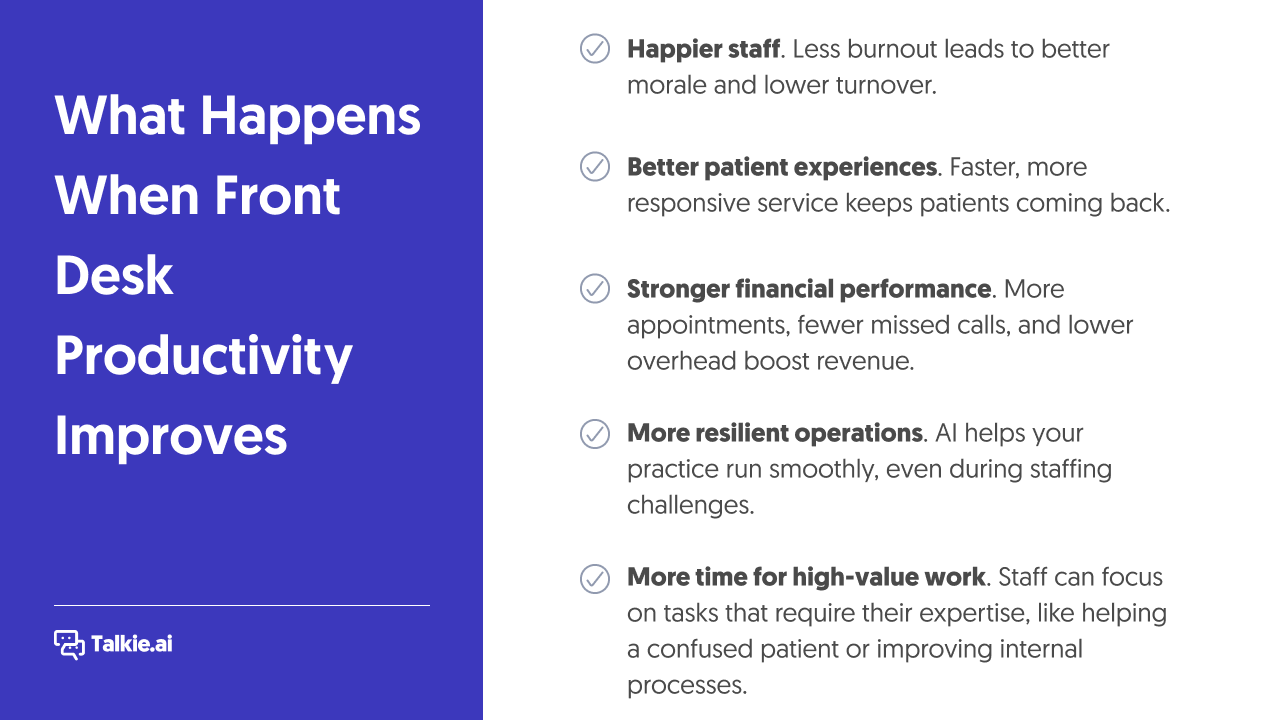
Improving productivity at the front desk isn’t just about getting through calls faster—it creates a ripple effect that touches every part of your practice.
Here are five second-order effects that come from investing in AI voice agents:
Ready to boost the productivity of your medical front desk?

Virtual agents can take care of the repeatable, administrative part of healthcare workers’ jobs. Here are the 4 most popular use...
How to get started with AI patient scheduling: a step-by-step guide for practice managers, from mapping rules to going live and measuring...